

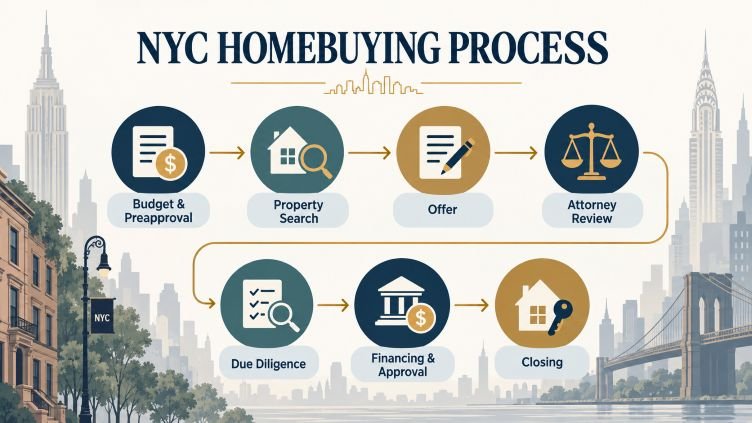
To buy a home in NYC, establish your complete budget, obtain mortgage preapproval, choose between a co-op, condo or house, identify suitable neighborhoods and assemble an experienced team. After finding a property, submit an offer, have your attorney conduct due diligence, sign the contract, complete financing and building approval requirements, perform a final walk-through and close.
Buying a home in New York City can feel like learning a new language. Listings mention maintenance, common charges, board packages, sponsor units, mansion tax and mortgage recording tax—often before you have decided which borough or property type suits you.
The process is manageable when you take it one decision at a time. The key is to understand your complete financial limit before searching and to investigate both the property and the building before signing a contract.
This guide explains how to buy a home in NYC, what makes the process different and where buyers need to be especially careful.
Key Takeaways
- Choose between a co-op, condominium and house before narrowing your search.
- Base your budget on total monthly and upfront costs—not the asking price alone.
- Mortgage preapproval makes your search more focused and your offer more credible.
- An accepted offer generally does not complete the purchase; the attorneys must negotiate and execute the contract.
- Co-op buyers usually face financial review and board approval.
- Condos and houses involve title ownership, while co-op purchasers acquire shares and a proprietary lease.
- Buyers of residential property priced at $1 million or more generally pay New York State’s mansion tax.
- Flood exposure, building finances, insurance and future assessments require careful investigation.
- Buyers should retain qualified legal, mortgage, inspection and real-estate professionals for their circumstances.
1. Decide What Type of NYC Home You Want
The first major decision is not the neighborhood. It is the form of ownership.
New York City buyers commonly choose among co-ops, condominiums and one- to four-family houses.
| Property type | What you own | Common advantages | Important considerations |
|---|---|---|---|
| Co-op | Shares in a corporation plus a proprietary lease | Often lower purchase price and lower buyer closing costs | Board approval, financial requirements and subletting rules |
| Condominium | Real property consisting of the unit plus an interest in common elements | Greater ownership flexibility and generally easier subletting | Higher purchase prices and additional title or mortgage costs |
| Townhouse or house | Land and building, subject to the deed and local rules | Privacy, space and control | Maintenance, inspection, insurance and repair responsibility |
| New development | Newly built or converted co-op or condo | Modern finishes, amenities and limited prior wear | Sponsor terms, construction risk and potentially higher closing costs |
Co-op
When you buy a co-op, you purchase shares in the corporation that owns the building. Your proprietary lease gives you the right to occupy a particular apartment.
Co-ops commonly review a buyer’s income, assets, debt, employment, post-closing liquidity and financial history. Many require a detailed board package and interview.
Before making an offer, investigate:
- Minimum down payment
- Debt-to-income expectations
- Post-closing liquidity requirements
- Subletting rules
- Pet rules
- Flip tax
- Renovation restrictions
- Board approval process
- Monthly maintenance
- Building financing
Condominium
A condominium buyer receives a deed to the unit and an ownership interest in the building’s shared elements.
Condos typically offer more flexibility than co-ops, but purchasers should still review:
- Common charges
- Property taxes
- Reserve funds
- Pending assessments
- Insurance
- Litigation
- Rental restrictions
- Renovation policies
- Right-of-first-refusal procedure
- Building condition
House or townhouse
A house may provide more privacy and control, but the owner assumes direct responsibility for the structure, roof, mechanical systems, utilities and exterior maintenance.
A detailed inspection is particularly important when buying a townhouse, detached home or multifamily property.
2. Calculate Your Complete NYC Homebuying Budget
The listing price is only the beginning.
Your budget must cover the down payment, closing costs, monthly housing expenses and cash reserves after closing.
Upfront costs
Plan for some combination of:
- Down payment
- Earnest-money or contract deposit
- Attorney’s fee
- Inspection
- Appraisal
- Lender charges
- Title search and title insurance
- Mortgage recording tax
- Mansion tax, where applicable
- Building application and move-in fees
- Homeowners or co-op insurance
- Adjustments paid at closing
- Immediate repairs or renovations
Monthly costs
Calculate:
- Mortgage principal and interest
- Co-op maintenance or condo common charges
- Property taxes
- Homeowners insurance
- Mortgage insurance, where applicable
- Utilities
- Parking or storage
- Maintenance and repair reserves
- Special assessments
A property with a lower asking price can be more expensive each month if it carries high maintenance, common charges, property taxes or assessments.
Keep post-closing reserves
Do not use every available dollar for the down payment and closing. You may need money for moving, repairs, furniture, assessments or unexpected expenses.
Co-op boards may also require buyers to demonstrate a specific amount of post-closing liquidity.
3. Check Whether You Qualify for Buyer Assistance
First-time buyers should investigate assistance before selecting a property because participating programs may impose income, purchase-price, property or occupancy requirements.
New York City’s HomeFirst program may provide eligible first-time buyers with up to $100,000 toward a down payment or closing costs. It operates as a zero-interest, forgivable loan and includes eligibility and homebuyer-education requirements. Program funding and terms can change, so verify them before relying on assistance. NYC Housing Partnership
Buyers may also investigate:
- State of New York Mortgage Agency programs
- Conventional low-down-payment mortgages
- FHA or VA financing, when eligible
- Employer-assisted housing
- Community lending programs
- Closing-cost grants
Speak with a qualified housing counselor and participating lender before assuming that a particular property or building will qualify.
Ready to turn your NYC budget into a realistic home search?
Complete our buyer form and share your budget, preferred boroughs, financing position and property requirements. One request can help focus your search on homes that fit your priorities.
4. Obtain Mortgage Preapproval
Unless you plan to pay entirely in cash, obtain mortgage preapproval before seriously touring homes.
A preapproval helps you:
- Understand your likely loan amount
- Estimate your monthly payment
- Identify documentation problems early
- Compare loan programs
- Submit a more credible offer
- Avoid searching above your financial range
Ask each lender for a written estimate that separates:
- Interest rate
- Annual percentage rate
- Loan fees
- Mortgage insurance
- Estimated taxes and insurance
- Cash required at closing
- Rate-lock terms
Confirm that the building is financeable
Approval of the borrower does not automatically mean approval of the property.
For condos and co-ops, lenders may review:
- Owner-occupancy levels
- Building insurance
- Commercial-space concentration
- Financial statements
- Reserve funds
- Litigation
- Delinquencies
- Sponsor ownership
- Building condition
Ask your lender about the building as early as possible.
5. Assemble Your NYC Homebuying Team
A typical NYC transaction may involve:
- Buyer’s real-estate agent
- Real-estate attorney
- Mortgage loan officer or broker
- Home inspector
- Insurance professional
- Accountant or financial adviser, when needed
Choose your attorney early
New York real-estate contracts are generally prepared and negotiated by attorneys. Retain an attorney familiar with NYC co-op, condo or residential transactions before making an offer.
Your attorney may review:
- Contract terms
- Title or lien information
- Building financial statements
- Offering plan and amendments
- Board minutes
- Insurance
- Assessments
- Litigation
- Violations
- Tax information
- Closing documents
Legal and financial decisions should be made with professionals who understand your transaction.
6. Choose the Right Borough and Neighborhood
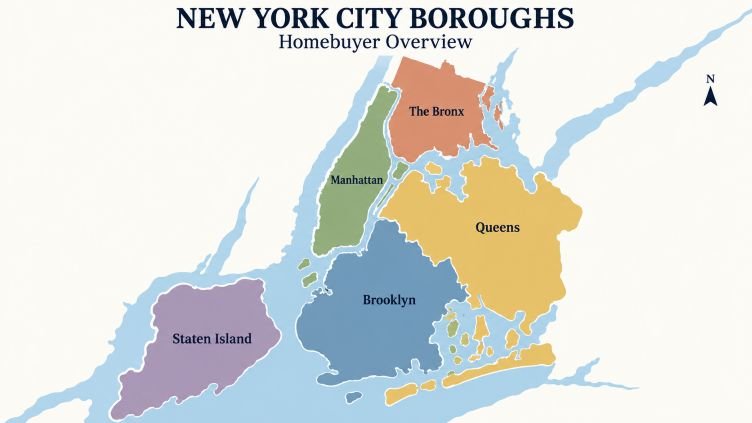
New York City consists of five boroughs, each containing many distinct housing markets.
Manhattan
Manhattan offers extensive condo and co-op inventory, access to major employment centers and a wide range of building styles. Purchase prices and monthly carrying costs can be high, and space may be limited.
Brooklyn
Brooklyn contains brownstones, townhouses, condos, co-ops and new developments. Prices and transportation access vary significantly among neighborhoods.
Queens
Queens offers condos, co-ops, detached houses and multifamily properties. Buyers should compare transit access carefully because travel convenience differs substantially across the borough.
The Bronx
The Bronx may provide comparatively accessible options in some areas, including co-ops, condos and houses. Housing conditions, transportation and ownership costs must be evaluated property by property.
Staten Island
Staten Island offers more detached and semi-detached homes than many other parts of NYC. Buyers should consider ferry, bridge, vehicle and commuting requirements.
Test the location in real life
Before choosing a neighborhood:
- Make the commute during working hours.
- Walk from the subway or bus stop.
- Check grocery stores, healthcare and daily services.
- Visit during the day, evening and weekend.
- Observe street noise and nearby land uses.
- Investigate construction and planned development.
- Research flood exposure.
- Compare monthly costs—not neighborhood reputation alone.
Use objective information when researching schools, crime, transportation and environmental conditions. Avoid relying on vague “best” or “safe” neighborhood claims.
7. Search for Suitable NYC Homes
Create two lists before looking at properties.
Non-negotiable requirements
Examples include:
- Maximum monthly payment
- Minimum bedrooms
- Elevator or accessible entrance
- Pet permission
- Workable commute
- Laundry requirements
- Financing-compatible building
- Outdoor space
- Home-office needs
Preferences
Examples include:
- View
- Doorman
- Gym
- Roof deck
- Particular architectural style
- Additional bathroom
- Parking
- Storage
Keeping the two lists separate prevents an attractive apartment from distracting you from important financial or practical requirements.
Explore our NYC homes for sale page to review available property types and locations.
8. Review the Listing Beyond the Photographs
Before scheduling a second visit or making an offer, look beyond staging and finishes.
For an apartment, review:
- Maintenance or common charges
- Property taxes
- Assessment history
- Flip tax
- Building amenities
- Subletting restrictions
- Pet policies
- Laundry
- Storage
- Renovation rules
- Sponsor ownership
- Days on market
- Price history
For a house, review:
- Property taxes
- Lot and building dimensions
- Certificate of occupancy
- Permits and alterations
- Roof and facade
- Heating and cooling
- Plumbing and electrical systems
- Basement condition
- Flood exposure
- Rental units and leases, if applicable
Verify material information through documents and appropriate professionals rather than relying exclusively on listing descriptions.
9. Attend Showings With a Consistent Checklist
Use the same checklist for every property.
Examine:
- Natural light
- Street and neighboring-building noise
- Water pressure
- Window condition
- Signs of moisture
- Floors and walls
- Heating and cooling
- Electrical outlets
- Storage
- Cell-phone reception
- Elevator and common areas
- Trash and delivery procedures
- Building security systems
- Renovation quality
Revisit serious candidates at a different time of day whenever possible.
10. Make an Offer
A typical offer may include:
- Purchase price
- Proposed down payment
- Financing information
- Mortgage contingency terms
- Desired closing timeline
- Flexibility requested from the seller
- Preapproval letter
- Proof of funds
- Relevant financial summary
Your offer strategy should reflect recent comparable sales, competing inventory, days on market, property condition and your financial limits.
An accepted offer is not the same as a signed contract
In a typical NYC resale transaction, the seller’s acceptance of an offer begins the attorney-review and contract-negotiation stage. The parties generally are not fully committed until the contract has been negotiated, signed and delivered.
Because legal consequences depend on the contract and circumstances, follow your attorney’s advice throughout this period.
11. Complete the Inspection and Due Diligence
Property inspection
Inspections are most extensive for townhouses and houses, but apartment buyers may also benefit from checking visible systems and conditions within the unit.
Depending on the property, an inspection may examine:
- Structure
- Roof
- Plumbing
- Electrical systems
- Heating and cooling
- Moisture
- Pests
- Appliances
- Windows
- Exterior condition
- Basement and drainage

Building due diligence
For a condo or co-op, your attorney should investigate the building—not only the apartment.
Important records may include:
- Offering plan
- Amendments
- Financial statements
- Operating budget
- Board minutes
- Proprietary lease or bylaws
- House rules
- Insurance
- Assessments
- Litigation
- Building violations
- Capital projects
- Reserve funds
A beautiful apartment can still be a poor purchase if the building has weak finances, unresolved structural work or major assessments ahead.
12. Review Flood and Climate Risk
Flood exposure is relevant in portions of all five boroughs.
Before signing a contract:
- Search the address using the NYC Flood Hazard Mapper and FEMA maps.
- Ask about previous flooding and water intrusion.
- Review basement and mechanical-equipment locations.
- Obtain flood-insurance information.
- Investigate planned resiliency projects.
- Review building insurance and deductibles.
- Ask whether assessments have followed previous storms.
The NYC Flood Hazard Mapper shows current coastal hazards, FEMA flood zones and areas that may face future risk. FloodHelpNY also provides address-based information and explains how building elevation and previous claims can influence flood-insurance costs. FloodHelpNY
A property outside a high-risk FEMA zone can still experience flooding from heavy rain, sewer backups or future coastal conditions.
13. Sign the Contract and Pay the Deposit
After due diligence and contract negotiations, the buyer generally signs first and submits the contract deposit. Ten percent is common in NYC resale transactions, but the amount is negotiable and may differ by property and deal structure.
The seller then signs, and the fully executed contract is delivered.
The contract should address matters such as:
- Purchase price
- Deposit
- Financing contingency
- Closing timeframe
- Included fixtures
- Property condition
- Representations
- Defaults
- Building approval
- Required documents
Never assume a verbal promise will be enforceable. Ask your attorney to address important terms in writing.
14. Complete the Mortgage Process
After contract signing, the lender proceeds with underwriting and appraisal.
Expect requests for documents such as:
- Bank statements
- Tax returns
- Pay statements
- Employment verification
- Identification
- Gift documentation
- Asset statements
- Debt information
- Contract and building documents
Avoid opening new credit, changing jobs, moving large unexplained sums or making major financed purchases before closing without consulting your lender.
15. Prepare the Co-op or Condo Application
Co-op board package
A co-op package may require:
- Financial statement
- Tax returns
- Bank and investment statements
- Employment letters
- Personal and professional references
- Landlord references
- Loan information
- Contract
- Identification
- Application fees
The board may also conduct an interview.
Submit accurate, consistent and complete information. If your financial profile does not meet the building’s expectations, it is better to identify that problem before making an offer.
Condo application
Condo boards generally have a right of first refusal rather than the same approval power exercised by a co-op board. The buyer still usually submits an application and supporting documents.
Your attorney and agent should explain the procedure for the particular building.
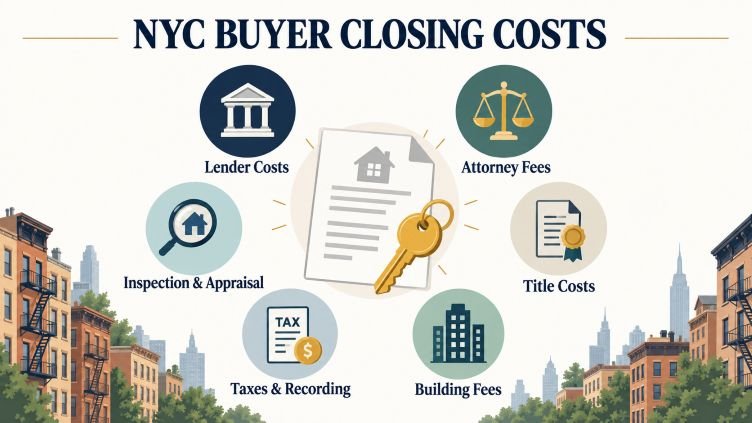
16. Understand NYC Buyer Closing Costs
Closing costs depend heavily on whether you buy a co-op, condo, house, resale or sponsor unit.
| Cost | Co-op | Condo or house |
|---|---|---|
| Buyer’s attorney | Usually | Usually |
| Inspection | When selected | Commonly recommended |
| Appraisal | With financing | With financing |
| Lender charges | With financing | With financing |
| Title insurance | Generally not conventional real-property title insurance | Common |
| Mortgage recording tax | Generally not charged on a co-op share loan | Generally applies to recorded mortgages |
| Building fees | Common | Common |
| Mansion tax | Applies at qualifying price | Applies at qualifying price |
| Move-in charges | Building dependent | Building dependent |
| Recording fees | Limited/different | Common |
Mansion tax
New York State generally imposes a 1% additional tax on residential purchases of $1 million or more. For residential purchases of $2 million or more, supplemental rates increase progressively, producing a combined rate that can reach 3.9% at the highest tier. The buyer generally pays this tax.
Review the current requirements with your attorney and the New York State Department of Taxation and Finance.
Sponsor and new-development costs
A sponsor may require the buyer to pay expenses that a seller commonly pays in a resale, including certain transfer taxes or the sponsor’s attorney fee.
Request a detailed closing-cost estimate before making an offer on new construction.
Get property-specific estimates
Ask your attorney and lender to prepare written estimates based on:
- Purchase price
- Property type
- Loan amount
- Building requirements
- Sponsor or resale status
- Expected closing date
Read our complete guide to NYC closing costs for homebuyers before establishing your final cash requirement.

Unsure whether a co-op, condo or house fits your budget?
Complete our buyer form once and tell us your budget, down payment, preferred boroughs and property requirements. We’ll use those details to help focus your search.
17. Obtain Insurance Before Closing
Insurance requirements depend on the property and lender.
Buyers may need:
- Homeowners insurance
- Condo unit-owner coverage
- Co-op insurance
- Flood insurance
- Additional liability coverage
- Coverage for renovations or valuable belongings
For apartments, review what the building’s master policy covers and what remains the unit owner’s responsibility.
Obtain quotations early. Previous claims, flood exposure, building condition and coverage limits may affect cost and availability.
18. Complete the Final Walk-Through
The final walk-through normally occurs shortly before closing.
Confirm that:
- The property is in the required condition.
- Included fixtures and appliances remain.
- Agreed work has been completed.
- Plumbing and electrical fixtures function.
- No new damage is visible.
- The property is vacant if required.
- The seller’s belongings have been removed.
- Keys, access devices and building information are available.
A final walk-through is not a new inspection. Report concerns to your attorney before closing.
19. Attend the Closing
At closing, the parties sign the required documents, funds are transferred and ownership documents are delivered.
The exact process differs among co-ops, condos and houses.
Co-op closing
The buyer typically receives documents related to the shares and proprietary lease.
Condo or house closing
The deed and mortgage documents are executed, and the transfer is recorded through the appropriate public offices.
Confirm wire instructions independently using a trusted telephone number. Real-estate wire fraud can involve convincing emails that appear to come from attorneys, lenders or title companies.
NYC Homebuying Timeline
| Stage | Typical activity |
|---|---|
| Financial preparation | Budget, credit review and preapproval |
| Property search | Neighborhood research, listings and showings |
| Offer | Price and key terms submitted |
| Due diligence | Inspection, attorney review and building research |
| Contract | Negotiation, signing and deposit |
| Financing | Appraisal, underwriting and commitment |
| Building process | Co-op board package or condo waiver |
| Pre-closing | Insurance, final figures and walk-through |
| Closing | Signatures, funds and ownership transfer |
Timelines vary. Financing, appraisal, building approval, title issues, repairs and document delays can all affect the closing date.
Common NYC Homebuying Mistakes
Shopping before establishing a complete budget
This can lead to disappointment or overlooked closing costs.
Assuming preapproval guarantees final financing
The lender must still approve the borrower, property and—where applicable—the building.
Choosing between a condo and co-op by price alone
Ownership rules, financing, subletting and closing costs can matter more than the initial price difference.
Skipping building due diligence
The apartment is only one part of the purchase. Building finances and planned work can affect future costs.
Ignoring assessments
Ask about current, approved and discussed assessments and how they will be allocated at closing.
Underestimating post-closing liquidity
This can create financial stress and may prevent approval in some co-ops.
Assuming an accepted offer guarantees the purchase
Other parties may continue negotiating until the contract is fully executed.
Ignoring flood exposure
Review both present and future risk before committing to a property.
Sending funds based only on emailed instructions
Verify every wire instruction through a separate, trusted communication method.
NYC Homebuyer Checklist
Before closing, confirm:
- Complete monthly budget
- Down payment and closing funds
- Mortgage preapproval
- Post-closing reserves
- Property-type decision
- Commute tested
- Attorney retained
- Inspection completed
- Building records reviewed
- Title or lien search completed
- Flood exposure investigated
- Insurance secured
- Co-op or condo application completed
- Closing disclosure or final statement reviewed
- Wire instructions independently verified
- Final walk-through completed
Related Questions
How much money do you need to buy a home in NYC?
The amount depends on the purchase price, property type, loan, building rules and closing costs. Co-ops may require larger down payments and substantial post-closing reserves, while condos may create higher title and mortgage-related costs.
Is it harder to buy a co-op than a condo?
A co-op often requires more financial documentation, board approval and compliance with stricter ownership rules. Condos usually offer more flexibility but tend to cost more and can have higher buyer closing expenses.
Do you need a lawyer to buy a home in NYC?
NYC real-estate transactions customarily involve attorneys who negotiate the contract and conduct legal due diligence. Retaining an experienced New York real-estate attorney is strongly advisable.
How long does it take to buy a home in NYC?
The timeline depends on financing, contract negotiations, title work and building approval. A co-op purchase may take longer because of the board package and interview.
Can you buy a NYC home with less than 20% down?
Some condos and houses may qualify for lower-down-payment financing. Many co-ops impose their own minimum down-payment requirements, which may exceed the lender’s requirement.
What is a flip tax?
A flip tax is a building-imposed transfer fee found in some co-ops and condos. It may be paid by the buyer or seller depending on the building documents and negotiated contract.
Who pays the buyer’s real-estate agent?
Compensation is determined by the relevant agreements and transaction terms. Buyers should review their representation agreement and request a written explanation of any amount they may owe.
Should first-time buyers choose a co-op or condo?
A co-op may provide a lower entry price but stricter rules. A condo may offer flexibility but require more cash for price and closing expenses. The correct choice depends on budget, future plans and the building’s requirements.
Final Thoughts: Buying the Right NYC Home
Buying a home in New York City is not only about finding an apartment you love. It is about confirming that the price, ownership structure, building finances, monthly costs and location work together.
Start with your budget. Decide whether a co-op, condo or house fits your plans. Assemble your professional team before making an offer, and allow your attorney, lender and inspector enough time to investigate the transaction.
The right home should still make sense after the excitement of the showing has passed and every recurring cost has been added.

Ready to Buy a Home in NYC?
Complete our buyer form and share your budget, preferred boroughs, property type, financing position and moving timeline. One request can help turn a citywide search into a focused list of homes worth considering.