
Quick Answer
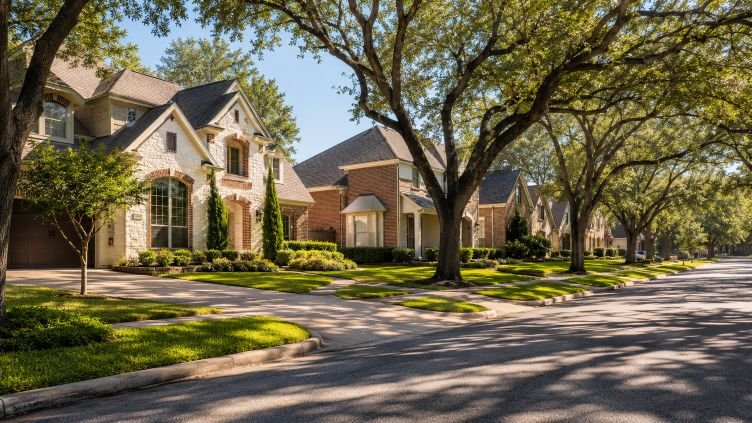
Buying a home in West Houston can provide access to established neighborhoods, newer communities, major employment centers, parks and a wide selection of property types. However, prices, property taxes, school assignments, flood exposure, insurance costs and commute times can vary significantly—even between nearby streets. Compare individual properties by total monthly cost and location, not by purchase price alone.
West Houston attracts buyers looking for more residential space while remaining connected to major business and commercial districts. Depending on where you search, you may find traditional single-family homes, townhomes, gated developments, golf-course properties, luxury residences and newer construction.
But West Houston is not one uniform housing market. A home near Memorial or the Energy Corridor may offer a very different price, tax bill, school assignment and commute from a property farther west or southwest.
This guide explains what to evaluate before buying so you can choose a home that fits both your lifestyle and your long-term budget.
Key Takeaways
- “West Houston” describes a broad part of the city rather than one precisely defined neighborhood.
- Housing prices and property types vary substantially among West Houston communities.
- Buyers should calculate taxes, insurance, HOA dues, maintenance and flood coverage before setting a budget.
- School attendance zones must be verified for the property’s exact address.
- Flood-zone status is important, but it should not be the only part of a buyer’s flood-risk investigation.
- Testing the commute during the hours you normally travel can prevent an expensive location mistake.
- A property-specific comparison is more reliable than choosing a neighborhood based on reputation alone.
What Is Considered West Houston?
West Houston is a broad geographic description, not a single subdivision or municipality with universally accepted boundaries.
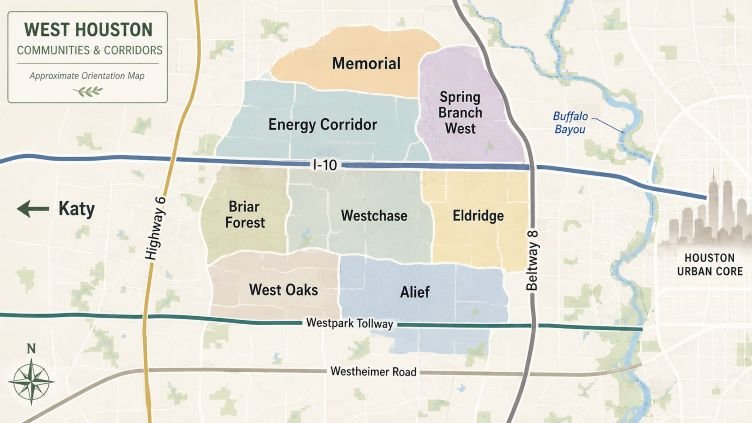
For homebuying purposes, the term commonly includes communities west of central Houston around Interstate 10, Beltway 8, Westheimer Road, Westpark Tollway and the western city limits. Depending on the source, it may include or overlap with areas such as:
- The Energy Corridor
- Memorial and Memorial West
- Briar Forest
- Westchase
- Spring Branch West
- Eldridge
- West Oaks
- Lakes on Eldridge
- Royal Oaks
- Parts of Alief
- Communities approaching Katy
This distinction matters because online listings, agents and local organizations may define West Houston differently. Before comparing prices or market statistics, confirm that every property is being compared within the same geographic area.
Is Buying a Home in West Houston a Good Decision?
Buying in West Houston can be a good decision for buyers who value housing choice, access to western employment centers, suburban-style neighborhoods and convenient connections to other parts of Houston.
The better question, however, is not whether West Houston is universally “good.” It is whether a particular West Houston property works for your budget, commute, insurance needs and daily routine.
Potential advantages
- Wide range of home styles and price points
- Access to the Energy Corridor and other employment centers
- Established neighborhoods with mature landscaping
- Newer and master-planned communities farther west
- Parks, trails, shopping, dining and medical facilities
- Access to I-10, Beltway 8 and Westpark Tollway
- Options ranging from townhomes to large detached houses
Important considerations
- Traffic conditions can change commute times substantially
- Property-tax rates vary by address and taxing jurisdiction
- Some properties have mandatory HOA dues
- Flood exposure and drainage history require careful research
- Insurance premiums may vary based on the home’s location, roof, age and claims history
- School assignments can change across neighborhood and district boundaries
- Older homes may require more maintenance or system upgrades
Explore homes that match your priorities—not just your price range. Tell us your budget, preferred locations and must-have features to receive help identifying suitable West Houston properties through one simple form.
What Types of Homes Can You Find in West Houston?
West Houston offers considerably more variety than a single neighborhood search may suggest.
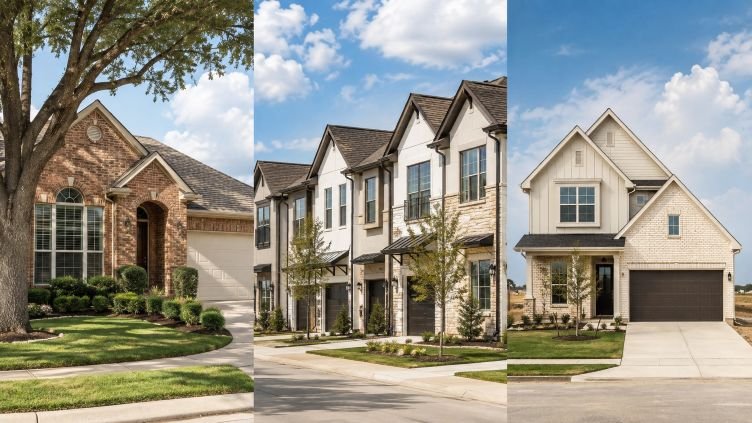
| Property type | Where buyers may encounter it | What to investigate |
|---|---|---|
| Established single-family homes | Memorial, Briar Forest, Energy Corridor and older subdivisions | Roof, plumbing, electrical system, foundation and drainage |
| Townhomes | Near employment, retail and higher-density corridors | HOA dues, parking, shared structures and insurance responsibilities |
| New-construction homes | Western growth areas and infill developments | Builder reputation, warranties, tax rate and future development |
| Gated-community homes | Various planned communities | Access rules, HOA restrictions and recurring fees |
| Luxury homes | Memorial-area and selected gated developments | Insurance, maintenance, security systems and resale demand |
| Golf-course properties | Selected planned communities | Lot premiums, golf-ball exposure, drainage and course-related restrictions |
| Waterfront or lakefront homes | Private lakes and water-oriented communities | Flood risk, shoreline maintenance and additional insurance |
Do not assume that newer automatically means lower maintenance or that an older home is a poor investment. The condition, construction quality, renovation history and price are more important than age alone.
How Much Does It Cost to Buy a Home in West Houston?
There is no reliable single price for all of West Houston because the area contains several distinct submarkets.
For wider context, HAR’s Houston profile reported approximately 17,382 homes for sale and an average home price of $471,961 in August 2026. That citywide figure should not be treated as the expected price for a particular West Houston neighborhood. Houston Association of Realtors
Your actual buying budget should include more than the listing price.
Costs to include in your calculation
- Down payment
- Mortgage principal and interest
- Property taxes
- Homeowners insurance
- Flood insurance, when required or selected
- HOA dues
- Inspection and appraisal expenses
- Title and lender charges
- Immediate repairs or renovations
- Ongoing maintenance
- Toll-road and transportation expenses
A less expensive home with high taxes, insurance and HOA dues may cost more each month than a higher-priced property with lower recurring expenses.
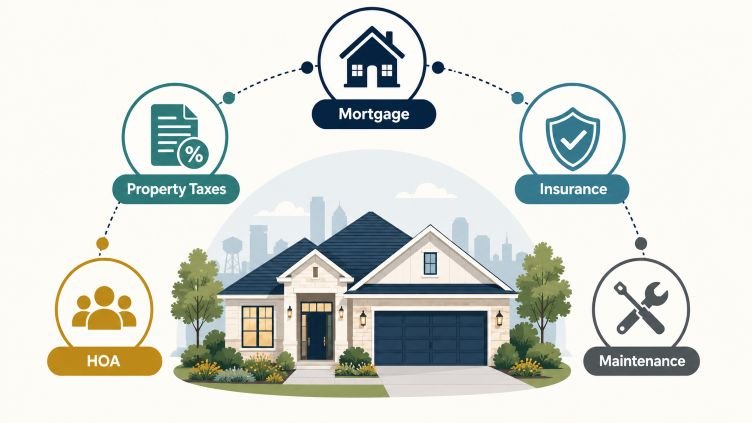
Compare total monthly ownership costs
| Cost | Property A | Property B |
|---|---|---|
| Mortgage payment | Request estimate | Request estimate |
| Property taxes | Verify by address | Verify by address |
| Homeowners insurance | Obtain quotation | Obtain quotation |
| Flood insurance | Obtain quotation | Obtain quotation |
| HOA dues | Verify documents | Verify documents |
| Estimated maintenance | Estimate by condition | Estimate by condition |
| Total monthly estimate | Calculate | Calculate |
Ask your lender to prepare estimates using the taxes, insurance and HOA costs associated with the actual properties you are considering.
How Do West Houston Property Taxes Work?
Texas does not have a state property tax. Property owners instead pay taxes to local jurisdictions, which may include the county, city, school district, flood-control district, community college district and other entities.
Two similarly priced West Houston homes can have different tax bills because they may fall within different taxing jurisdictions or qualify for different exemptions.
When investigating a property:
- Search the property through the Harris Central Appraisal District.
- Review its current appraised and taxable values.
- Identify every taxing jurisdiction.
- Check the applicable tax rates.
- Determine whether the seller’s exemptions will disappear after closing.
- Ask how a new purchase or future appraisal could affect the tax bill.
- Do not base your estimate solely on the seller’s current payment.
Eligible owner-occupants may apply for a residence homestead exemption. HCAD states that qualifying homeowners currently receive at least a $140,000 exemption for school-district taxes, while Harris County provides a 20% optional homestead exemption for qualifying homeowners. Verify current eligibility and amounts directly with Harris Central Appraisal District.
Which School District Serves West Houston?
West Houston crosses multiple school-district and attendance-zone boundaries. Depending on the exact address, a home may be served by:
- Houston Independent School District
- Spring Branch Independent School District
- Alief Independent School District
- Katy Independent School District
- Another nearby district in the broader western area
Never rely only on a listing description, neighborhood name or proximity to a school. Verify the assigned schools directly with the relevant district before making an offer.
The Texas Education Agency provides accountability information and an address-based map through TXschools.gov. TEA released its 2026 A–F accountability ratings in August 2026, but buyers should evaluate more than one rating. Consider academic programs, transportation, enrollment, campus resources and whether the school meets the student’s individual requirements. Texas Education Agency
School boundaries and programs can change. A buyer should independently confirm all information with the district.
What Should Buyers Know About Flood Risk?
Flood risk should be investigated for every Houston-area property, including homes outside designated high-risk zones.
Start by searching the exact address through the FEMA Flood Map Service Center. FEMA explains that properties in high-risk flood areas with government-backed mortgages are generally required to carry flood insurance. FEMA flood-insurance guidance

A flood-zone designation is only one part of the investigation. Buyers should also ask:
- Has the structure or lot flooded previously?
- Has water entered the garage or approached the house?
- Were flood-related repairs completed?
- Were permits obtained for major repairs?
- Has the property experienced repeated drainage problems?
- Is the home elevated relative to the street and neighboring lots?
- Are there nearby bayous, detention areas or drainage channels?
- What are the flood-insurance options and estimated premiums?
- Are there pending or completed drainage projects nearby?
Most homeowners policies do not cover flooding caused by rising water. The Texas Department of Insurance also notes that more than half of the homes flooded during Hurricane Harvey were outside designated flood zones. Texas Department of Insurance home-insurance guide
Obtain homeowners and flood-insurance quotations before the option period expires. Insurance cost can materially change the affordability of a property.
How Should You Evaluate a West Houston Commute?
West Houston provides access to major transportation corridors, but proximity on a map does not guarantee a predictable commute.
Important routes include:
- Interstate 10
- Beltway 8/Sam Houston Tollway
- Westpark Tollway
- Westheimer Road
- Memorial Drive
- Richmond Avenue
- Eldridge Parkway
- Highway 6
Test the route from the property to your workplace or regular destination during the hours you expect to travel. Also test school, grocery, medical and airport trips when those journeys matter to your household.
Consider:
- Normal rush-hour travel time
- Toll-road costs
- Alternative routes
- Traffic near major intersections
- Distance to everyday services
- Work-from-home requirements
- Access during severe weather or road closures
A property that costs slightly more but reduces frequent travel may offer greater practical value than a less expensive home with a difficult commute.
What Parks and Amenities Are Available?
West Houston includes shopping districts, restaurants, medical facilities, employment centers, parks and trail systems. Recreational options vary by location, but notable western-area amenities include Terry Hershey Park, Buffalo Bayou trails and neighborhood park facilities.
The Houston Police Department’s Westside Division identifies Terry Hershey Park, Mike Driscoll Park and the Buffalo Bayou Hike and Bike Trail among the area’s major landmarks. It also lists the Energy Corridor, Westchase Corridor, Memorial City Mall and several medical and commercial destinations. City of Houston
When comparing neighborhoods, look beyond the distance shown on a map. Visit the area and determine whether the amenities you value are easy to reach in practice.
Should You Buy an Older Home or New Construction?
Both options can work well, but they involve different tradeoffs.
| Factor | Established home | New construction |
|---|---|---|
| Location | Often in mature neighborhoods | More common in growth areas or infill sites |
| Lot and landscaping | May offer larger lots and mature trees | Often newer landscaping and planned amenities |
| Maintenance | Older systems may require replacement | Lower initial maintenance, but defects are still possible |
| Design | Traditional layouts or renovated interiors | Contemporary layouts and energy features |
| Inspection | Essential | Still essential, including phased inspections |
| Costs | Renovation may be required | Builder upgrades, premiums and higher taxes may apply |
| Community | Existing neighborhood conditions are visible | Future construction and amenities may be incomplete |
For new construction, investigate the builder, warranty, tax estimate, HOA, planned development and completion schedule. Hire an independent inspector rather than relying only on the builder’s quality-control process.
For established homes, pay close attention to the roof, HVAC system, foundation, plumbing, electrical components, drainage and previous renovations.
Not sure whether an established home or new construction fits your budget? Share your preferred price, commute and home features through our buyer form, and we’ll help narrow the West Houston options worth exploring.
What Should You Inspect Before Buying?
A general home inspection is an important starting point, but the property may require additional specialist evaluations.
Depending on the home, consider investigating:
- Foundation movement
- Roof condition and remaining life
- HVAC age and performance
- Plumbing material and sewer line
- Electrical panel and wiring
- Drainage and grading
- Termite or wood-destroying insect activity
- Pool equipment
- Chimney or fireplace
- Previous additions and permits
- Moisture or mold concerns
- Irrigation system
- Trees near the structure
- New-construction workmanship
Review the seller’s disclosure, inspection report and repair estimates together. A long list of findings does not automatically make a home unsuitable, but the cost and urgency of the repairs should influence your offer and reserves.
What Should You Know About HOAs?
Many West Houston communities have homeowners associations, but fees and responsibilities differ.
Before closing, review:
- Current HOA dues
- Special assessments
- Transfer and resale-certificate fees
- Architectural restrictions
- Leasing restrictions
- Pet and parking rules
- Maintenance responsibilities
- Community amenities
- Pending litigation
- Reserve funding
- Recent meeting minutes, when available
Do not assume that a gated entrance means the community provides security or that the HOA maintains every exterior feature. Read the governing documents carefully.
What Insurance Questions Should You Ask?
Request insurance estimates early—preferably before submitting an offer or during the option period.
Ask about:
- Homeowners premium and deductible
- Wind and hail deductible
- Flood-insurance availability
- Roof age and insurability
- Replacement-cost versus actual-cash-value coverage
- Prior property claims
- Water or sewer-backup coverage
- Foundation or slab exclusions
- Required repairs
- Discounts for updated systems
The Texas Department of Insurance recommends asking the owner for the property’s CLUE report, which shows insurance claims filed over recent years. Past claims and repairs may affect both your risk assessment and insurance cost. Texas Department of Insurance
What Is the West Houston Homebuying Process?
1. Define your real budget
Calculate the cash needed for the down payment, inspections, appraisal, closing and immediate repairs. Then establish an affordable monthly cost that includes taxes, insurance and HOA dues.
2. Obtain mortgage preapproval
A preapproval helps clarify your price range and shows sellers that you have started the financing process. Compare the interest rate, annual percentage rate, lender fees, mortgage-insurance requirements and estimated cash to close.
3. Identify your location priorities
Rank commute, home size, school needs, parks, shopping, property condition and future plans. Separate essential requirements from preferences.
4. Compare individual neighborhoods
Visit at different times and evaluate traffic, noise, access, nearby land uses and general property upkeep. Use objective property and government data rather than relying on broad neighborhood descriptions.
5. Tour suitable homes
Compare condition and total cost—not just appearance. Keep notes because homes can become difficult to distinguish after several showings.
6. Investigate before making an offer
Review available disclosures, taxes, HOA information, flood data and an initial insurance estimate.
7. Submit a strategic offer
Price matters, but so do financing, option period, closing date, appraisal terms and other contingencies. Structure the offer around your financial limits and risk tolerance.
8. Complete inspections and due diligence
Use the option period efficiently. Review inspection findings, obtain specialist opinions and request repair estimates when necessary.
9. Complete appraisal, title and financing
Respond promptly to lender requests, review the title commitment and avoid opening new credit or making major financial changes before closing.
10. Conduct the final walk-through
Confirm the property’s condition, negotiated repairs and included items before signing the closing documents.
West Houston Buyer Checklist
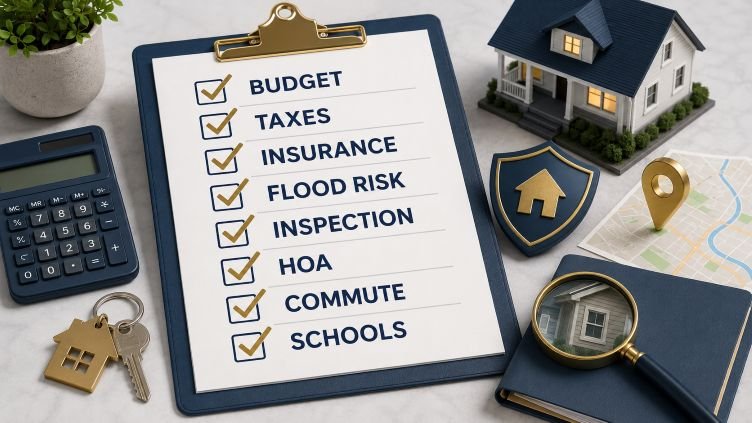
Before making a final decision, verify:
- Exact property boundaries and legal description
- Total monthly payment
- Property-tax estimate after purchase
- Homestead-exemption eligibility
- Homeowners-insurance quotation
- Flood-zone information and flood-insurance quotation
- Seller’s disclosure and previous claims
- Independent inspection findings
- HOA dues, restrictions and assessments
- Assigned schools with the district
- Commute during realistic travel hours
- Nearby planned development and land uses
- Repair and maintenance reserves
- Title commitment and survey
- Final cash required at closing
Related Questions
Is West Houston suitable for first-time buyers?
West Houston may suit first-time buyers because it offers different property types and price points. However, buyers should compare the complete monthly payment and retain savings for inspections, repairs, insurance deductibles and ongoing maintenance.
Are property taxes high in West Houston?
Property-tax bills vary by property value, exemptions and taxing jurisdictions. Buyers should retrieve the property record from HCAD and calculate an estimate based on the expected post-purchase value rather than relying on the seller’s current tax payment.
Does every West Houston home require flood insurance?
Not necessarily. Lenders generally require flood insurance for certain high-risk properties, but buyers outside those zones may still choose coverage. Most standard homeowners policies do not cover rising-water flood damage.
Which West Houston neighborhood is best?
There is no single best neighborhood for every buyer. The right choice depends on budget, commute, home type, required amenities, school needs, property condition and tolerance for recurring costs.
Should I buy a new or existing home?
New construction may provide modern layouts and warranties, while established homes may offer mature locations and larger lots. Compare taxes, inspections, maintenance, builder quality, neighborhood development and total ownership cost.
When should I request an insurance quote?
Request it as early as possible, ideally before making an offer or during the option period. Waiting until shortly before closing may reveal an unexpectedly high premium or coverage restriction too late in the process.
Conclusion: Is Buying in West Houston Right for You?
West Houston may be a strong choice if you want access to western employment centers, varied housing options, established amenities and neighborhoods ranging from mature communities to newer development. After reading this article, you can make the right choice before relocating.
Its variety is also why careful comparison is essential. Two nearby homes can produce very different financial and practical outcomes once taxes, insurance, flood exposure, HOA dues, repairs and commute time are considered.
The best West Houston home is not necessarily the newest property, the lowest-priced listing or the home in the most widely recognized neighborhood. It is the property whose location, condition and complete ownership cost support your plans without placing unnecessary pressure on your budget.
Ready to begin your West Houston home search? Complete our buyer form once and tell us your budget, preferred areas, timeline and must-have features. We’ll use those priorities to help identify West Houston homes that deserve a closer look.