
Quick Answer
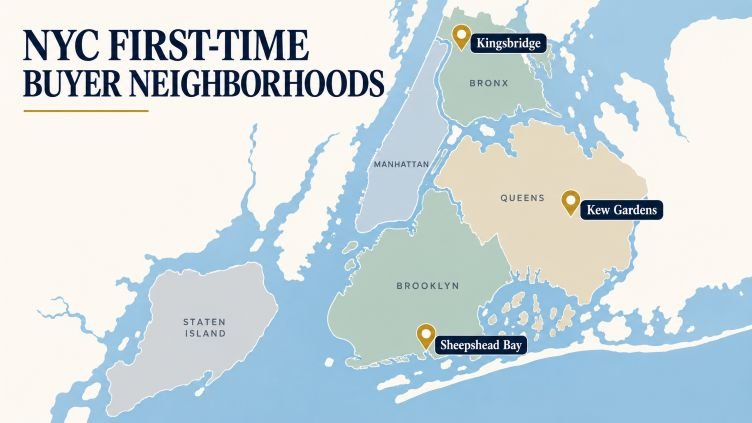
Some of the best NYC neighborhoods for first-time buyers include Kew Gardens, Rego Park, Jackson Heights, Kingsbridge, Pelham Parkway, Sheepshead Bay, Bay Ridge, and St. George.
These neighborhoods make the list because they offer a practical combination of starter-home inventory, transportation access, relative value, and different property types. The right choice depends on more than the listing price, however. Buyers should also compare maintenance charges, property taxes, building finances, commute options, flood exposure, and resale restrictions.
There is no universally “best” NYC neighborhood. The best fit is the one that supports your budget, commute, space requirements, and long-term ownership plans.
Homes for sale in New York City
Key Takeaways
- Queens and the Bronx generally offer more lower-priced co-op choices than central Manhattan and brownstone Brooklyn.
- Kew Gardens, Sheepshead Bay, and Bay Ridge appeared among StreetEasy’s strongest NYC buyer markets for 2026.
- A lower asking price does not always mean a lower monthly payment.
- Co-ops can provide a less expensive entry point, but often require larger financial reserves and board approval.
- Buyers considering waterfront or low-lying properties should investigate flood risk and insurance before making an offer.
- Eligible first-time buyers may qualify for as much as $100,000 through NYC’s HomeFirst program.
- Get fully preapproved before comparing neighborhoods so that you understand your real purchase-price range.
The Best NYC Neighborhoods for First-Time Buyers at a Glance
| Neighborhood | Borough | Common starter options | Strongest fit for | Important tradeoff |
|---|---|---|---|---|
| Kew Gardens | Queens | Co-ops and condos | Buyers prioritizing value and transit | Co-op rules and maintenance vary |
| Rego Park | Queens | Co-ops and condos | Buyers wanting shopping and subway access | Busy commercial corridors |
| Jackson Heights | Queens | Prewar co-ops | Buyers seeking character and multiple transit options | Limited condo inventory in some sections |
| Kingsbridge | Bronx | Co-ops, condos and small houses | Buyers balancing space and subway access | Housing stock changes block by block |
| Pelham Parkway | Bronx | Co-ops and condos | Buyers seeking larger apartment layouts | Longer trip to parts of Manhattan |
| Sheepshead Bay | Brooklyn | Co-ops, condos and houses | Buyers seeking comparatively lower Brooklyn prices | Flood diligence is important near the water |
| Bay Ridge | Brooklyn | Co-ops and condos | Buyers who want Brooklyn ownership options below prime-area pricing | Longer subway commute |
| St. George | Staten Island | Condos, co-ops and houses | Buyers prioritizing space and ferry access | Commutes away from Lower Manhattan can be complex |
How We Selected These Neighborhoods
“Best” can mean something different to every buyer. This guide therefore uses objective homebuying factors rather than assumptions about who should live in a particular area.
The main criteria include:
- Availability of homes that can work as first purchases
- Relative asking prices within the NYC market
- Co-op, condo and house inventory
- Subway, rail, ferry or bus access
- Typical monthly ownership expenses
- Building and financing considerations
- Potential compromises involving space, commute or property type
Market conditions can change quickly. In its 2026 buyer-market analysis, StreetEasy found that inventory was increasing and asking prices were declining in several neighborhoods. Based on December 2025 listing data, the median asking price was approximately $365,000 in Kew Gardens, $515,000 in Sheepshead Bay and $699,000 in Bay Ridge. These figures describe asking prices—not final sale prices or the price of every home in those neighborhoods.
1. Kew Gardens, Queens
Kew Gardens is one of the most compelling starting points for buyers who want to remain near major transit while exploring comparatively accessible ownership options.
The neighborhood contains a substantial number of co-op apartments, along with condos and a smaller selection of houses. Prewar buildings can offer layouts that feel more generous than similarly priced new construction.
The MTA system includes service at Kew Gardens–Union Turnpike, while the neighborhood also has Long Island Rail Road access. Buyers should verify service schedules and test the actual door-to-door commute rather than relying only on the nearest station.
Why first-time buyers consider Kew Gardens
- Co-ops can provide a lower-cost entry into ownership.
- The neighborhood offers both subway and commuter-rail possibilities.
- StreetEasy’s December 2025 data placed its median asking price at $365,000.
- Inventory had increased by 7.7% year over year in the same data set.
What to investigate
A co-op with a low asking price may still have high maintenance charges or demanding financial requirements. Review the building’s financial statements, underlying mortgage, planned assessments, sublet rules and reserve expectations.
Best practical fit: Buyers comfortable with co-op ownership who prioritize value and transportation over new-building amenities.
2. Rego Park, Queens
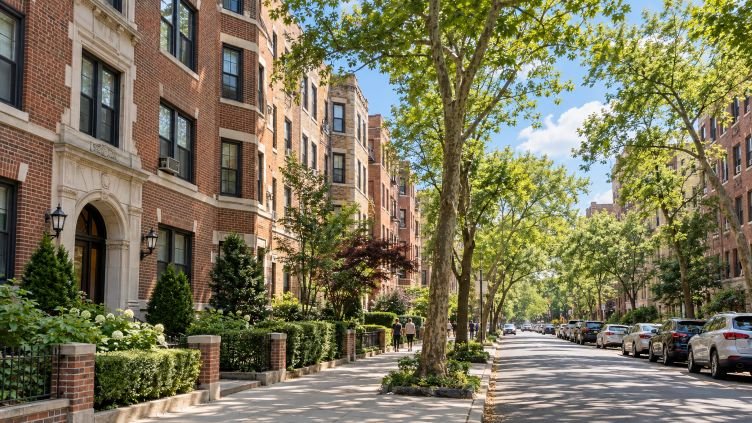
Rego Park offers a broad mix of apartment buildings, commercial conveniences and subway access. Many first-time buyers begin here because the neighborhood often has more attainable co-op listings than western Queens or Manhattan.
Housing options range from compact starter apartments to larger prewar units. Condos are available too, although they may carry a price premium compared with similar co-ops.
Why first-time buyers consider Rego Park
- A sizable stock of co-op apartments
- Access to several Queens subway stations
- Everyday shopping within or near the neighborhood
- A variety of building ages and apartment sizes
What to investigate
Compare total monthly costs, not only asking prices. Two similar apartments can have very different maintenance charges, assessment histories and included utilities.
Buyers should also visit at different times of day. Proximity to Queens Boulevard, shopping areas or major intersections may be convenient for one buyer and less appealing to another.
Best practical fit: Buyers seeking apartment inventory and day-to-day convenience with direct subway access.
3. Jackson Heights, Queens
Jackson Heights is particularly appealing to buyers who like prewar architecture, established co-op buildings and access to a major transit hub.
The Jackson Heights–Roosevelt Avenue complex provides multiple subway connections, making the neighborhood worth considering for buyers whose schedules require more than one possible route. The MTA map confirms connections serving Jackson Heights, Rego Park and other central Queens neighborhoods.
Why first-time buyers consider Jackson Heights
- A notable supply of prewar co-ops
- Multiple subway routes in and around the neighborhood
- Apartment buildings with distinctive architectural details
- A wide selection of restaurants and local businesses
What to investigate
Some buildings have stricter co-op requirements than others. Buyers should confirm down-payment rules, debt-to-income expectations, post-closing liquidity requirements and policies covering renovations or subletting.
Parts of Jackson Heights are within a historic district, so exterior alterations to affected properties may be regulated. This generally matters more to buyers considering townhouses or major exterior projects than to someone purchasing an ordinary apartment.
Best practical fit: Buyers who prefer prewar apartments and want more than one potential transit route.
4. Kingsbridge, the Bronx
Kingsbridge can offer an appealing combination of apartment inventory, transit and relative value. Buyers may find co-ops and condos as well as a limited selection of smaller houses.
Its location near multiple Bronx transportation options makes it practical for buyers commuting to upper Manhattan or other parts of the Bronx. Exact convenience varies considerably depending on the property’s distance from a station and the buyer’s final destination.
Why first-time buyers consider Kingsbridge
- Co-op inventory at prices that may be below many Manhattan alternatives
- Apartment layouts with more space than some similarly priced central-city properties
- Access to subway and bus service
- A mix of large apartment buildings and lower-density streets
What to investigate
The experience can differ from block to block, particularly around elevated train lines and heavily traveled roads. Walk from the property to the station, grocery store and other frequently used destinations before making an offer.
For co-ops, pay close attention to building reserves, maintenance increases and restrictions on future renting.
Best practical fit: Buyers seeking space and transit who are open to expanding their search into the Bronx.
5. Pelham Parkway, the Bronx
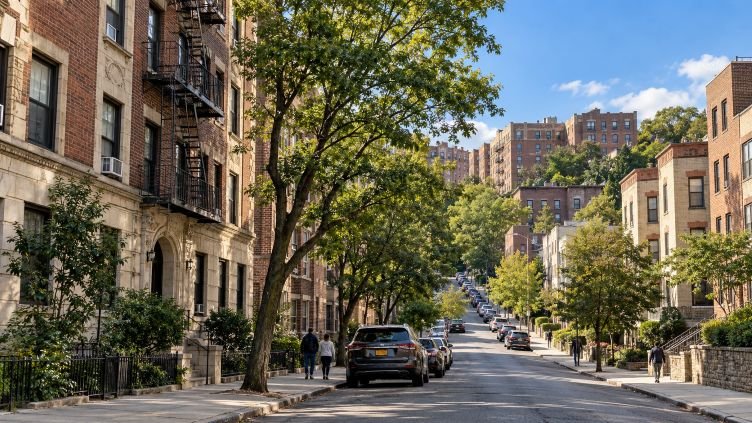
Pelham Parkway has a substantial collection of apartment buildings, including many co-ops with layouts that can work for buyers who need more than a studio or compact one-bedroom.
The neighborhood’s transportation and green-space access can be attractive, but commute time depends heavily on the buyer’s destination. A neighborhood can look convenient on a subway map while still producing a long door-to-door trip.
Why first-time buyers consider Pelham Parkway
- Larger apartment layouts in portions of the neighborhood
- Co-op and condo choices
- Access to subway and bus connections
- Potentially more space for the purchase price than in central Manhattan
What to investigate
Look beyond the apartment itself. Evaluate the building’s elevator history, façade work, insurance costs, reserves and recent capital projects.
A low monthly maintenance figure is not automatically positive if the building has deferred necessary repairs.
Best practical fit: Buyers who place space and purchase price ahead of having the shortest possible Manhattan commute.
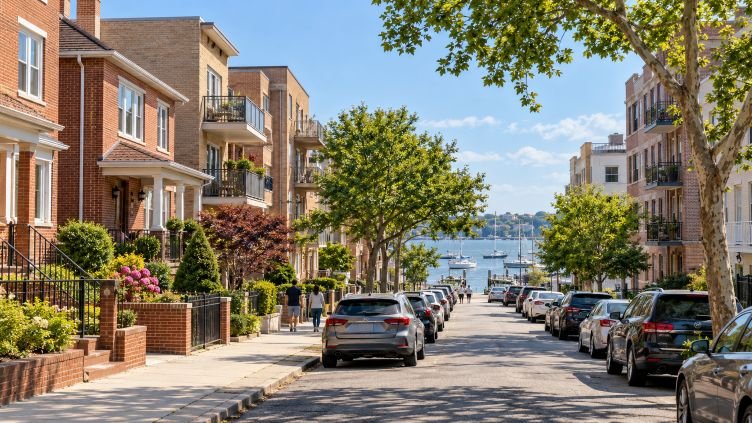
6. Sheepshead Bay, Brooklyn
Sheepshead Bay stands out for buyers hoping to own in Brooklyn without focusing exclusively on its highest-priced sections.
StreetEasy reported a median asking price of $515,000 in December 2025, down 19.4% from the previous year, while for-sale inventory reached 325 homes. That does not mean every property was inexpensive, but it suggests buyers had a comparatively broad selection and greater room to compare listings.
The neighborhood offers co-ops, condos and houses, with subway service available at Sheepshead Bay and nearby stations.
Why first-time buyers consider Sheepshead Bay
- One of the lower median asking prices on StreetEasy’s 2026 buyer-market list
- More property-type variety than many apartment-dominated neighborhoods
- Subway access
- A large pool of listings in the cited market analysis
What to investigate
Some properties are near the water or in areas with potential flood exposure. Check the individual address instead of assuming that risk is uniform throughout the neighborhood.
NYC advises buyers to consult applicable flood maps. The city notes that federally backed mortgages on buildings in FEMA-designated high-risk areas may require flood insurance, which is separate from a standard homeowners policy.
Best practical fit: Buyers seeking comparatively accessible Brooklyn options who are willing to conduct careful property-specific flood due diligence.
7. Bay Ridge, Brooklyn
Bay Ridge gives first-time buyers another way to enter the Brooklyn market, particularly through co-ops and smaller condos.
StreetEasy’s December 2025 data showed a median asking price of $699,000, a 4.2% annual decline, and a 6.7% increase in available homes. The same analysis placed Bay Ridge among NYC’s ten strongest buyer markets for 2026.
The R train serves several stations through the neighborhood, although the trip to central Manhattan may be longer than buyers expect.
Why first-time buyers consider Bay Ridge
- Co-op and condo choices at different price points
- More inventory than in some smaller Brooklyn neighborhoods
- Subway, bus and ferry possibilities
- Options ranging from compact apartments to larger homes
What to investigate
Test the commute during the hours when you will actually travel. A buyer working remotely most days may judge the tradeoff differently from someone commuting to Midtown five times a week.
Monthly maintenance, parking availability and flood exposure near the waterfront also require property-specific review.
Best practical fit: Buyers who want a Brooklyn address and are comfortable trading a longer commute for additional options or space.
8. St. George, Staten Island
St. George can be worth considering for buyers prioritizing space, ferry access and a range of property types. The neighborhood includes condos, co-ops and houses, sometimes at prices below comparable properties in closer-in parts of Brooklyn or Manhattan.
Its strongest transportation advantage is access to the Staten Island Ferry. That can work particularly well for Lower Manhattan commuters, while trips to Midtown, Queens or the Bronx may require more transfers.
Why first-time buyers consider St. George
- Ferry access to Lower Manhattan
- Condos, co-ops and houses
- Potential for more interior space
- An alternative to an apartment-only search
What to investigate
Calculate the complete commute, including travel to the ferry terminal, waiting time and the trip from Whitehall Terminal to your workplace.
Buyers considering houses should budget for expenses that an apartment owner may share through a building, including exterior maintenance, roofing, heating equipment and landscaping.
Waterfront and hillside conditions should also be reviewed at the exact property level.
Best practical fit: Buyers who value space or ferry access and whose regular travel patterns work with Staten Island’s transportation network.
Ready to compare actual listings instead of broad neighborhood averages?
Find NYC Homes That Fit My Budget through the Booming Properties buyer form.
What Can a First-Time Buyer Actually Afford in NYC?
Start with the monthly payment you can carry comfortably—not the maximum mortgage a lender might approve.
Your calculation should include:
- Mortgage principal and interest
- Property taxes
- Co-op maintenance or condo common charges
- Homeowners insurance
- Mortgage insurance, when applicable
- Flood insurance, if required or advisable
- Utilities
- Transportation or parking expenses
- Expected maintenance and repairs
- A reserve for future assessments
A $400,000 co-op with high maintenance may cost more each month than a $450,000 condo with lower common charges. Conversely, a condo’s property taxes and purchase closing costs may be higher.
Ask your lender to model several property types before deciding on a neighborhood.

Co-op, Condo or House: Which Is Better for a First Purchase?
Choose a co-op if:
- Lower purchase prices are your main priority.
- You are comfortable with board approval.
- You can meet the building’s financial requirements.
- You do not need maximum flexibility to rent the property later.
Choose a condo if:
- You want fewer restrictions on resale or leasing.
- You prefer a simpler approval process.
- You can accommodate a potentially higher purchase price and closing costs.
Choose a house if:
- You want greater control over the property.
- You are prepared to manage repairs and maintenance.
- You have enough reserves for unexpected expenses.
- Your preferred neighborhoods have suitable house inventory.
Neither structure is automatically better. The right choice depends on your finances and how long you expect to own the property.
NYC Assistance for First-Time Buyers
Eligible buyers should investigate the NYC HomeFirst Down Payment Assistance Program early—preferably before beginning serious property tours.
According to ACCESS NYC, qualified buyers may receive up to $100,000 toward a down payment or closing costs. The maximum is generally the lesser of $100,000 or 20% of the purchase price.
The program may be used for qualifying one- to four-family homes, condominiums and cooperatives in the five boroughs. Requirements include income eligibility, an approved homebuyer education course, a buyer contribution, a participating lender and primary-residence commitments. Program terms and income limits can change, so confirm current eligibility directly with an approved counselor.
NYC first-time homebuyer programs
How to Choose Between These Neighborhoods
1. Get a property-specific preapproval
Tell the lender whether you are considering co-ops, condos or houses. A lender that approves a condo purchase may still need to review an individual co-op building.
2. Set a complete monthly-cost ceiling
Your cap should include taxes or maintenance—not merely the mortgage payment.
3. Choose three commute-compatible areas
Test weekday and weekend routes. Include walking, transfers and delays.
4. Compare ten or more relevant listings
One unusually low-priced apartment can distort your perception of a neighborhood. Review a meaningful sample of properties that meet your space requirements.
5. Read building information before getting attached
Ask for maintenance charges, taxes, assessments, financing restrictions and sublet policies before investing too much time in a listing.
6. Tour the surrounding blocks
Visit during the day and evening. Pay attention to train noise, traffic, access to necessities and the real walk to transportation.
7. Investigate the individual property
Neighborhood comparisons cannot replace building and address-level due diligence. Review inspection findings, financial records, insurance, liens, title issues and applicable flood information with qualified professionals.
Want a shortlist based on your budget, commute and preferred property type?
Find NYC Homes That Fit My Budget through the Booming Properties buyer form.
Questions to Ask Before Making an Offer
- What have comparable homes actually sold for?
- How long has the property been listed?
- Has the asking price changed?
- Are there current or planned assessments?
- What does the monthly fee include?
- How much liquidity does the co-op require after closing?
- Are there restrictions on financing, renovations or subletting?
- Does the building have an underlying mortgage?
- Is the property in or near a mapped flood-risk area?
- What insurance coverage will the lender require?
- Are major building projects planned?
- What will the buyer’s full closing costs be?
- Does the property qualify for the buyer’s loan program?
Frequently Asked Questions
What is the most affordable NYC borough for first-time buyers?
The answer depends on property type and monthly expenses. The Bronx often offers lower-priced co-ops, while Staten Island may provide more house and condo options for the money. Queens has a broad selection of co-ops across neighborhoods such as Kew Gardens, Rego Park and Jackson Heights.
Compare individual properties rather than relying on a borough-wide average.
Is Queens a good place for a first-time buyer?
Queens can be a practical starting point because it offers a large and varied ownership market. Buyers can compare co-ops, condos and houses across neighborhoods with different transportation options. Kew Gardens, Rego Park and Jackson Heights are especially useful places to begin an apartment search.
Where can I find an affordable home in Brooklyn?
Sheepshead Bay and Bay Ridge can offer lower-priced alternatives to many central and brownstone Brooklyn neighborhoods. Affordability still varies by property type, building expenses and exact location.
Should a first-time buyer purchase a co-op?
A co-op can provide an attainable entry price, but buyers must be prepared for board approval, financial scrutiny and building-specific restrictions. Review both the apartment and the corporation’s finances before proceeding.
How much money should I save before buying in NYC?
In addition to the down payment, save for closing costs, inspections, attorney fees, moving expenses and post-closing reserves. Co-op boards may require buyers to retain substantial liquid assets after closing.
Can I buy an NYC home with less than 20% down?
Potentially. Available loan programs depend on the property, lender and buyer’s qualifications. Some co-op buildings impose their own financing limits even when a lender would allow a smaller down payment.
Are there first-time buyer programs in NYC?
Yes. HomeFirst may provide qualified buyers with up to $100,000 for a down payment or closing costs, subject to program requirements. Buyers should contact an approved counseling agency for current eligibility information.
Which neighborhood is best for commuting to Manhattan?
It depends on the Manhattan destination. Jackson Heights and central Queens may suit some Midtown commuters, while St. George can work for buyers traveling to Lower Manhattan. Test the exact route from each property.
Final Thoughts
The strongest neighborhood for a first-time NYC buyer is rarely the one with the lowest advertised price. It is the one where the purchase price, monthly costs, building rules, commute and long-term plans work together.
Begin with Kew Gardens, Rego Park or Jackson Heights if you want a Queens apartment search with several transit options. Consider Kingsbridge or Pelham Parkway if value and space matter more than a central location. Explore Sheepshead Bay or Bay Ridge for comparatively accessible Brooklyn ownership, and look at St. George if ferry access and additional space fit your routine.
Once your budget is verified, compare individual buildings—not just neighborhoods. In New York City, the financial health and rules of a building can matter as much as its address.
Take the next step toward your first NYC home.
Find NYC Homes That Fit My Budget through the Booming Properties buyer form.