

The purchase price may be the biggest number in a New York City real estate transaction, but it is not the only number buyers need to prepare for.
In addition to the down payment, a buyer may need cash for legal fees, lender charges, title insurance, building fees, prepaid expenses and several New York taxes. Which expenses apply depends heavily on whether the property is a co-op, condominium, house or sponsor unit—and whether the purchase is financed.
How much are closing costs for buyers in NYC?
As a preliminary planning estimate:
| Property and financing type | Suggested buyer closing-cost budget |
|---|---|
| Resale co-op purchased with cash | Approximately 1%–2% |
| Financed resale co-op | Approximately 1%–3% |
| Resale condo or house purchased with cash | Approximately 1.5%–3% |
| Financed resale condo or house | Approximately 3%–5% |
| Purchase of $1 million or more | Add the applicable mansion tax |
| New-development condo | Frequently 4%–6% or more |
These percentages are starting points, not fixed rates. A buyer’s actual total can change based on the mortgage amount, purchase price, title premium, lender, building charges, contract terms and the number of months of taxes or insurance collected at closing.
The down payment is not technically a closing cost. It does, however, form part of the buyer’s total cash requirement. The Consumer Financial Protection Bureau’s Loan Estimate guide explains that estimated cash to close generally combines the down payment and closing costs, then subtracts the contract deposit, seller credits and other applicable adjustments.
Not sure how much cash you will need?
Get a property-specific estimate based on your budget, financing and preferred type of NYC home.
Why are closing costs in NYC relatively high?
Several expenses can overlap in a financed New York City purchase:
- Mortgage recording tax on a condo or house
- Title insurance and title-related searches
- Mansion tax on purchases of $1 million or more
- Attorney and lender expenses
- Building application, move-in and administrative charges
- Prepaid property taxes, insurance and interest
- Sponsor expenses shifted to the buyer in some new-development contracts
This is why an online NYC closing-cost calculator should be treated as a preliminary budgeting tool. A reliable estimate should account for the property type, mortgage amount and individual deal terms.
Co-op vs. condo vs. house closing costs
The property structure creates one of the biggest differences in NYC buyer closing costs.
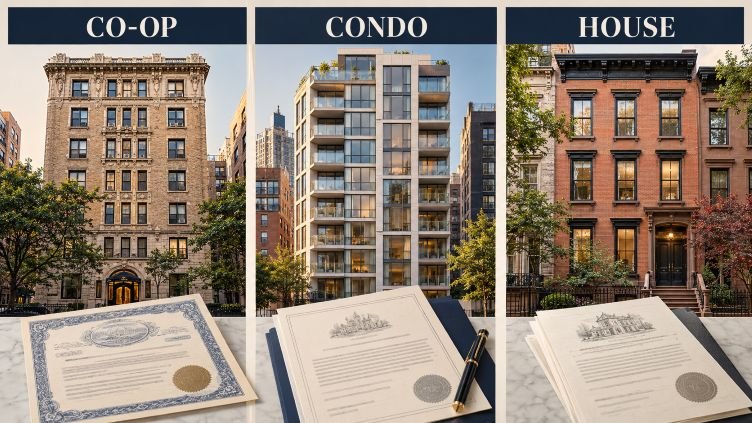
| Expense | Co-op | Condo | One- to three-family house |
|---|---|---|---|
| Buyer’s attorney | Yes | Yes | Yes |
| Lender and appraisal fees when financed | Yes | Yes | Yes |
| Mortgage recording tax | Generally no | Yes | Yes |
| Traditional owner’s title insurance | Generally no | Yes | Yes |
| Lien/UCC searches | Yes | May apply | May apply |
| Mansion tax at $1 million or more | Yes | Yes | Yes |
| Building application and move fees | Common | Common | Usually not |
| Inspection | Sometimes | Recommended | Strongly recommended |
| Survey | No | Usually no | May be recommended |
| Homeowners insurance | Building-specific | Yes | Yes |
Why are co-op closing costs usually lower?
When buying a co-op, the buyer purchases shares in a cooperative corporation and receives a proprietary lease. The buyer does not receive a deed to an individual parcel of real property.
As a result, a co-op buyer generally does not purchase conventional owner’s title insurance or pay mortgage recording tax. A financed co-op still comes with lender charges, legal expenses, lien searches and building fees, but avoiding those two large expenses can significantly reduce the closing budget.
The lower closing cost does not automatically make a co-op the better choice. Buyers must also consider board approval, financial requirements, subletting policies, maintenance charges and resale restrictions.
Why do condos and houses cost more to close?
A condo or house purchase involves the transfer of real property. A financed buyer will typically encounter title expenses and New York City mortgage recording tax in addition to ordinary legal and lender costs.
The NYC Department of Finance confirms that combined state and city mortgage recording taxes apply when a mortgage is recorded against NYC real estate and that the rate depends on the mortgage amount.
Typical closing costs paid by an NYC buyer
Buyer’s attorney
New York buyers generally hire an attorney to review the contract, examine due-diligence materials, coordinate with the lender and title company, and represent them at closing.
Legal fees vary with the property and transaction complexity. New construction, estate sales, investment entities, unusual title issues and compressed timelines can increase the fee.
A buyer should ask whether the quote includes contract review, due diligence, lender coordination and attendance at closing—and what circumstances would trigger an additional charge.
Mortgage recording tax
The mortgage recording tax applies to mortgages recorded against real property, which normally means condos and houses rather than co-ops.
For preliminary budgeting, the buyer portion is commonly estimated at:
| Mortgage amount | Commonly used buyer planning rate |
|---|---|
| Less than $500,000 | Approximately 1.80% |
| $500,000 or more | Approximately 1.925% |
These percentages are applied to the mortgage amount, not the property’s entire purchase price. The precise calculation can be affected by the property, mortgage documents, exemptions and transaction structure, so the lender and closing attorney should confirm it.
New York State publishes the underlying mortgage-tax framework on its Mortgage Recording Tax page, while NYC provides local filing information through the Department of Finance.
For example, a buyer taking an $800,000 mortgage might initially budget approximately:
$800,000 × 1.925% = $15,400
That is a planning calculation, not a final tax statement.
Title insurance and title searches
Condo and house buyers commonly purchase owner’s title insurance to protect against covered ownership claims, liens and defects. A lender will normally require a separate lender’s title policy when a mortgage is involved.
Title expenses depend on the purchase price, mortgage amount, applicable endorsements and searches. Buyers should obtain a transaction-specific title quote rather than relying on a fixed national percentage.
Co-op buyers generally use lien and Uniform Commercial Code searches instead of conventional real-property title insurance.
Mansion tax
New York State imposes a mansion tax when residential consideration reaches $1 million. In New York City, higher price tiers are subject to supplemental rates.
| NYC residential purchase price | Total mansion-tax rate |
|---|---|
| $1 million to less than $2 million | 1.00% |
| $2 million to less than $3 million | 1.25% |
| $3 million to less than $5 million | 1.50% |
| $5 million to less than $10 million | 2.25% |
| $10 million to less than $15 million | 3.25% |
| $15 million to less than $20 million | 3.50% |
| $20 million to less than $25 million | 3.75% |
| $25 million or more | 3.90% |
The rate applies to the full consideration—not merely the amount above the threshold. The official thresholds and rules are available from the New York State Department of Taxation and Finance.
That creates a notable pricing threshold:
- Mansion tax at $999,999: $0
- Mansion tax at $1,005,000: $10,050
A $5,001 increase in price therefore creates an additional $10,050 buyer tax. Buyers negotiating near $1 million should evaluate the complete cash requirement rather than focusing only on the price difference.
Lender and appraisal charges
A financed purchase may include:
- Origination or underwriting charges
- Credit-report fee
- Appraisal fee
- Bank attorney fee
- Flood determination or tax-service fee
- Discount points, if selected
- Rate-lock or extension charges in applicable situations
Buyers should compare the same sections on competing Loan Estimates rather than comparing interest rates alone. The CFPB recommends reviewing origination charges, services and total cash to close when comparing offers.
Prepaid expenses and escrow funding
Some amounts collected at closing are advance payments rather than transaction fees. They can include:
- Daily mortgage interest from closing through the end of the month
- Homeowners insurance premium
- Initial property-tax escrow deposit
- Initial insurance escrow deposit
- Property-tax adjustments owed to the seller
- Common charges or maintenance adjustments
The closing date can affect these numbers. For example, closing late in the month may reduce prepaid mortgage interest, although it should not determine the date if doing so creates other transactional risks.
Building-related charges
Co-op and condo buildings may impose:
- Managing-agent fees
- Board or application fees
- Credit-check fees
- Recognition-agreement fees
- Move-in deposits
- Move-in or elevator fees
- Working-capital contributions
- Maintenance or common-charge adjustments
A refundable move deposit still requires available cash, even though the buyer may receive it back after complying with the building’s moving procedures.
Inspection and specialist reports
A professional inspection can reveal defects that are not apparent during a showing. Houses commonly require the most comprehensive inspections, but condo and co-op buyers may also benefit from inspecting the unit’s accessible systems and interior conditions.
Depending on the property, buyers may also consider sewer-line, structural, mold, radon, environmental or engineering evaluations.
Who pays the transfer taxes in NYC?
In a typical resale, the seller generally pays the New York State real estate transfer tax and the NYC Real Property Transfer Tax.
The standard state transfer tax is $2 for every $500 of consideration, equivalent to 0.4%.
For qualifying residential transfers—including individual co-ops, condos and one- to three-family houses—the NYC transfer-tax rates are:
- 1% when the consideration is $500,000 or less
- 1.425% when the consideration is more than $500,000
The rates are published on the NYC Real Property Transfer Tax page.
The combined ordinary seller-side transfer-tax rates are therefore generally:
| Consideration | NYS tax | NYC tax | Combined rate |
|---|---|---|---|
| $500,000 or less | 0.40% | 1.00% | 1.40% |
| More than $500,000 | 0.40% | 1.425% | 1.825% |
These costs matter to buyers because a new-development or sponsor contract may require the buyer to pay transfer taxes that would ordinarily be paid by the seller.
Worked NYC buyer closing-cost examples
The following illustrations assume resale condos, conventional financing and no unusual contract provisions. Actual title, lender, escrow and building charges can vary considerably.

Example 1: Buying a $500,000 condo
Assumptions:
- Purchase price: $500,000
- Down payment: 20%, or $100,000
- Mortgage: $400,000
- Mansion tax: None
| Estimated item | Planning amount |
|---|---|
| Mortgage recording tax | Approximately $7,200 |
| Title and related searches | Approximately $2,500–$4,500 |
| Buyer’s attorney | Approximately $2,000–$4,000 |
| Lender, appraisal and bank-attorney charges | Approximately $2,000–$5,000 |
| Prepaids, adjustments and escrow funding | Approximately $2,000–$6,000 |
| Building and miscellaneous charges | Approximately $500–$2,000 |
| Estimated closing costs | Approximately $16,200–$28,700 |
| Estimated total cash including down payment | Approximately $116,200–$128,700 |
Any contract deposit already paid would be credited toward the final cash-to-close figure.
Example 2: Buying a $750,000 condo
Assumptions:
- Purchase price: $750,000
- Down payment: 20%, or $150,000
- Mortgage: $600,000
- Mansion tax: None
| Estimated item | Planning amount |
|---|---|
| Mortgage recording tax | Approximately $11,550 |
| Title and related searches | Approximately $3,000–$5,000 |
| Buyer’s attorney | Approximately $2,000–$4,000 |
| Lender, appraisal and bank-attorney charges | Approximately $2,000–$5,000 |
| Prepaids, adjustments and escrow funding | Approximately $2,000–$8,000 |
| Building and miscellaneous charges | Approximately $1,000–$3,000 |
| Estimated closing costs | Approximately $21,550–$36,550 |
| Estimated total cash including down payment | Approximately $171,550–$186,550 |
A $750,000 co-op financed at the same loan-to-value ratio could have meaningfully lower costs because mortgage recording tax and conventional title insurance would generally not apply. The buyer would still need to budget for legal, lender, lien-search, building and prepaid expenses.
Example 3: Buying a $1 million condo
Assumptions:
- Purchase price: $1,000,000
- Down payment: 20%, or $200,000
- Mortgage: $800,000
- Mansion tax: 1%, or $10,000
| Estimated item | Planning amount |
|---|---|
| Mortgage recording tax | Approximately $15,400 |
| Mansion tax | $10,000 |
| Title and related searches | Approximately $4,000–$6,000 |
| Buyer’s attorney | Approximately $2,000–$4,000 |
| Lender, appraisal and bank-attorney charges | Approximately $2,000–$5,000 |
| Prepaids, adjustments and escrow funding | Approximately $3,000–$10,000 |
| Building and miscellaneous charges | Approximately $1,000–$3,000 |
| Estimated closing costs | Approximately $37,400–$53,400 |
| Estimated total cash including down payment | Approximately $237,400–$253,400 |
These figures demonstrate why a buyer’s budget should not end with the down payment. A household with exactly $200,000 available would not have enough cash for this example without a different financing structure, additional funds or approved credits.
Planning to buy a home in NYC?
Get help estimating your down payment, closing costs and property-specific expenses before you make an offer.
New-development closing costs in NYC
New construction often has the highest buyer closing costs because the sponsor’s contract may shift expenses to the purchaser.
Depending on the offering plan and negotiated contract, buyers may be asked to pay:
- Sponsor’s NYC and New York State transfer taxes
- Sponsor’s attorney fee
- Unit closing or document fees
- Working-capital contribution
- Resident-manager apartment contribution
- Initial common charges
- Mortgage recording tax
- Title insurance
- Mansion tax when the purchase reaches the applicable threshold
For a purchase above $500,000, ordinary city and state transfer taxes total 1.825% before any contract-specific tax treatment or calculation adjustments. On a $1.5 million property, a simple 1.825% illustration equals $27,375—before title, mortgage, mansion tax, legal fees and other expenses.
Not every sponsor contract shifts every expense, and negotiability depends on the development and market. Buyers should ask their attorney to prepare a line-by-line estimate before the contract becomes binding.
Can closing costs be negotiated?
Some can. Government taxes generally cannot be negotiated away, but responsibility for certain costs can be negotiated between the parties.
Potential negotiating points include:
- Seller credit toward permitted buyer costs
- Sponsor payment of transfer taxes
- Sponsor attorney fee
- Building move or processing fees
- Repair credit
- Lender credit in exchange for a different interest rate
- Purchase CEMA cooperation
A credit is not necessarily free money. A higher purchase price can affect the appraisal, financing, mansion-tax threshold and future carrying costs. Loan programs also limit which costs a seller or lender may cover.
Can closing costs be rolled into a mortgage?
Usually, buyers cannot simply add every closing expense to a standard purchase mortgage. The approved loan-to-value ratio, appraisal, lender guidelines and loan program control the maximum mortgage amount.
A transaction may reduce upfront cash through:
- An approved seller credit
- A lender credit
- Certain financed loan expenses
- A higher purchase price supported by the appraisal
- Eligible down-payment or closing-cost assistance
- A Purchase CEMA that reduces mortgage recording tax
Each option has tradeoffs. A lender credit, for example, may come with a higher interest rate. Buyers should compare both the immediate cash savings and the longer-term borrowing cost.
What is a Purchase CEMA?
A Purchase Consolidation, Extension and Modification Agreement may allow part of the seller’s existing mortgage to be assigned and combined with the buyer’s new loan. When available, the buyer may pay mortgage recording tax only on the new-money portion rather than the entire new mortgage.
A Purchase CEMA requires cooperation among the buyer, seller, existing lender, new lender and attorneys. It also introduces assignment, bank and legal fees. It is generally associated with condos and houses because co-op financing does not involve a recorded real-property mortgage.
The potential tax saving should be compared with the additional fees and possible scheduling complications. Buyers should ask about feasibility early, not shortly before closing.
Are cash-buyer closing costs lower?
Usually. A cash buyer avoids mortgage recording tax and lender expenses, including appraisal, origination and bank-attorney charges.
A cash condo or house buyer may still pay:
- Buyer’s attorney
- Owner’s title insurance and searches
- Mansion tax, when applicable
- Inspection costs
- Recording and filing charges
- Building fees
- Tax and common-charge adjustments
A cash co-op can be less expensive to close, but the building may still review the purchaser’s assets and impose its normal application and move-in requirements.
Are NYC closing costs tax-deductible?

Most closing costs are not immediately deductible. Some expenses may be added to the property’s tax basis, while qualifying mortgage interest, points and real estate taxes may receive different treatment under federal tax rules.
The IRS explains these distinctions in Publication 530, Tax Information for Homeowners. It notes that certain settlement expenses may be added to basis, while only specified costs qualify for a current deduction.
Rules also differ for a primary residence, second home and investment property. Buyers should retain the final closing statement and consult a qualified tax professional about their particular use of the property.
Assistance for first-time NYC buyers
Qualified purchasers may be eligible for programs that help with the down payment or closing costs.
NYC’s HomeFirst Down Payment Assistance Program currently describes assistance of up to $100,000 for eligible buyers purchasing an approved one- to four-family home, condominium or cooperative. Income limits, education requirements, occupancy rules, property requirements and funding availability apply.
Buyers should investigate assistance before signing a contract because program approval and property review can affect financing and timing.
Hidden closing expenses buyers sometimes overlook
Post-closing liquidity
A co-op board may require the buyer to retain a specified amount of liquid assets after closing. That reserve is not paid at closing, but it limits how much of the buyer’s savings can be used toward the down payment and costs.
Rate-lock extensions
If a transaction takes longer than expected, the buyer may have to pay to extend an expiring mortgage-rate lock.
Building assessments
An existing or upcoming assessment may affect both the monthly budget and negotiations. The contract should state how applicable assessments will be handled.
Immediate repairs and moving costs
Furniture, movers, painting, renovations and repairs are not closing costs, but they still compete for the same post-purchase cash.
Insurance requirements
Older buildings, flood zones, property condition and intended use can affect the availability and price of insurance.
Wire-fraud risk
Buyers should independently confirm wiring instructions using a trusted telephone number. Last-minute instructions received only by email should be treated cautiously, particularly if the account information has changed.
How to estimate your cash to close

Use this sequence before making an offer:
- Identify whether the property is a co-op, condo, house or sponsor sale.
- Estimate the down payment and mortgage amount.
- Add mortgage recording tax when financing a condo or house.
- Add mansion tax if the purchase price is at least $1 million.
- Obtain an attorney estimate.
- Request lender fees and anticipated prepaid amounts.
- Obtain a title quote for a condo or house.
- Review the listing, offering plan or building documents for buyer fees.
- Add an emergency buffer for changes and post-closing expenses.
- Subtract the contract deposit and confirmed credits when estimating the final amount due.
Before closing, compare the lender’s final Closing Disclosure with the latest Loan Estimate. The CFPB recommends checking both the closing-cost total and cash-to-close calculation.
Frequently asked questions
What percentage should a buyer budget for closing costs in NYC?
A financed co-op buyer might begin with approximately 1%–3% of the purchase price. A financed condo or house buyer might start with approximately 3%–5%. New development and purchases subject to mansion tax can require more.
Does the buyer pay NYC transfer taxes?
Ordinarily, the seller pays the NYC and New York State transfer taxes in a resale. A sponsor contract or negotiated agreement can shift those expenses to the buyer.
Do co-op buyers pay mortgage recording tax?
Generally, no. A co-op loan is secured by cooperative shares and a proprietary lease rather than by a recorded mortgage against individual real property.
Do buyers pay mansion tax on co-ops?
Yes. The mansion tax can apply to a qualifying residential co-op, condo or house purchase when the consideration reaches $1 million.
What happens when the price is exactly $1 million?
The 1% mansion tax applies to the entire $1 million, producing a $10,000 buyer tax.
Are NYC closing costs based on the price or mortgage?
It depends on the expense. Mansion tax and title premiums are generally connected to the purchase price, while mortgage recording tax is based on the recorded mortgage amount. Other expenses are fixed, quote-based or determined by the building.
How much are closing costs for a $750,000 NYC property?
A financed resale condo might require approximately $21,550–$36,550 under the assumptions used in this guide. A comparable co-op may cost less to close because conventional title insurance and mortgage recording tax generally do not apply.
Can a seller pay all of the buyer’s closing costs?
Not always. The contract can provide a credit, but loan-program, appraisal and underwriting limits may restrict the amount and the expenses it can cover.
When will the buyer know the final amount?
A lender provides a Loan Estimate during the mortgage process and a Closing Disclosure before closing. The attorney, lender, title company and managing agent then coordinate the final adjustments and amount due.
Plan for the whole purchase—not only the down payment
NYC buyer closing costs vary too much for a single percentage to be accurate in every transaction. A co-op can avoid two of the largest condo expenses, a mortgage can trigger recording tax, a $1 million price can introduce mansion tax, and a sponsor contract can transfer significant seller expenses to the buyer.
The safest approach is to prepare a property-specific estimate before making an offer. That estimate should combine the down payment, taxes, title or lien expenses, professional fees, building charges, prepaids and a post-closing reserve.

Get a clearer NYC home-buying budget.
Tell us your target price, preferred property type and financing plan. We’ll help you evaluate available NYC properties with the full purchase budget in mind.
This article provides general educational information and planning estimates. Tax rates, program requirements, lender charges and contract terms may change. Buyers should obtain transaction-specific advice from their attorney, lender, title professional and tax adviser.