

New York City may operate as one city, but your monthly expenses can look very different depending on whether you live in Manhattan, Brooklyn, Queens, the Bronx, or Staten Island.
Housing creates the largest difference in the cost of living in different NYC boroughs. Transportation, property type, car ownership, building fees, insurance, utilities, and everyday shopping also affect how much you actually need each month.
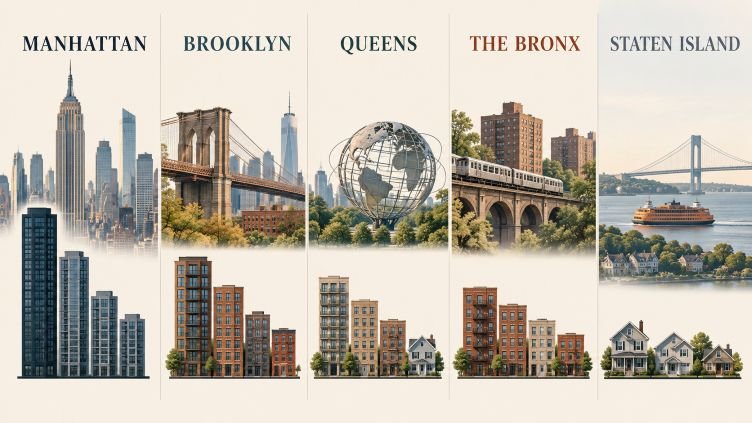
Manhattan generally has the highest housing costs. The Bronx usually offers the lowest entry point for buyers, while Queens often provides a useful balance between housing prices and transportation. Brooklyn has one of the widest price ranges, and Staten Island can offer more space while adding car, commuting, and home-maintenance expenses.
Quick Answer: Which NYC Borough Has the Lowest Cost of Living?
The Bronx generally has the lowest borough-wide housing costs in New York City. Staten Island can also provide comparatively affordable living, especially for buyers seeking a house or more space, but transportation and car expenses can raise the total monthly cost.
Queens typically costs less than Brooklyn, while Manhattan remains the most expensive borough overall.
The most affordable borough for a particular household depends on:
- Whether the household rents or buys
- Preferred property type
- Required number of bedrooms
- Monthly building charges
- Workplace location
- Need for a car
- Property taxes and insurance
- Childcare and other household expenses
NYC Borough Cost Comparison
| Borough | 2025 median asking home price | Q2 2026 median asking rent | Relative housing cost | Important cost consideration |
|---|---|---|---|---|
| Manhattan | $1,350,000 | $5,117 | Highest | Purchase price and building charges |
| Brooklyn | $1,100,000 | $4,054 | High but highly variable | Prices decline farther from Manhattan |
| Queens | $700,000 | $3,561 | Moderate by NYC standards | Transportation costs differ by neighborhood |
| The Bronx | $399,000 | $3,171 | Generally lowest | Building condition and commute |
| Staten Island | $769,000 | Comparable rental data under review | Moderate for buyers | Car ownership and home maintenance |
StreetEasy reported the borough-level home-price figures for 2025. Realtor.com reported the rental figures for the second quarter of 2026. Asking prices are not the same as completed sale prices, and borough-wide medians should not be treated as the price of every available property.
New York metropolitan household expenditures
What Is the Average Cost of Living in New York City?
There is no single monthly figure that accurately represents every New York City household. A person renting a studio in Manhattan has a very different budget from a homeowner with two cars on Staten Island.
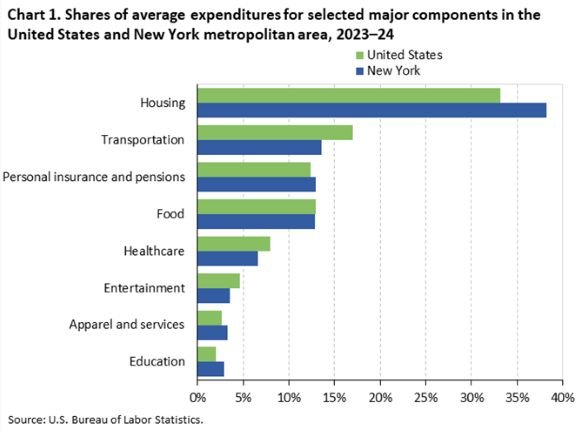
The Bureau of Labor Statistics reported that households in the broader New York metropolitan area spent an average of $91,520 annually during 2023–24. Housing represented 38.2% of household spending, transportation accounted for 13.6%, and food represented 12.8%.
These statistics cover the wider New York metropolitan area, not only the five boroughs. They still demonstrate that housing is normally the largest component of the region’s household budget.
Your personal NYC budget may include:
- Rent or mortgage payments
- Property taxes
- Co-op maintenance or condo common charges
- Renters or homeowners insurance
- Electricity, gas, water, and internet
- Subway, bus, ferry, or commuter-rail fares
- Car payments, insurance, parking, fuel, and tolls
- Groceries and dining
- Childcare
- Healthcare
- Building assessments
- Home repairs and maintenance
- Entertainment and personal expenses
Because housing dominates most NYC budgets, it is helpful to begin the borough comparison there.
Cost of Living in Manhattan
Manhattan generally has the highest cost of living among the five boroughs.
Its 2025 median asking home price was approximately $1.35 million. During the second quarter of 2026, its median asking rent reached $5,117, up 9% from a year earlier.
Those borough-level figures include very different markets. A luxury condo in Tribeca, a prewar co-op on the Upper West Side, and a one-bedroom apartment in Washington Heights cannot be evaluated using one price expectation.
Manhattan housing expenses
Prospective Manhattan buyers may need to budget for:
- A larger down payment
- Higher purchase prices
- Co-op maintenance
- Condo common charges
- Property taxes
- Building assessments
- Move-in and move-out fees
- Mansion tax on purchases of $1 million or more
- Higher closing costs for certain transactions
A lower-priced Manhattan co-op can still be expensive to carry if the maintenance charge is high. Buyers should compare the complete monthly payment rather than assuming that the apartment with the lower asking price is more affordable.
Transportation savings in Manhattan
One financial advantage is the ability to live without a car. Extensive subway and bus coverage can allow a household to avoid:
- Car payments
- Auto insurance
- Parking charges
- Fuel
- Tolls
- Routine repairs and maintenance
These savings will not erase Manhattan’s higher housing costs, but they can reduce the difference for households that would otherwise maintain one or more vehicles.
Comparatively lower-cost areas of Manhattan
Buyers looking for relatively attainable Manhattan properties may consider exploring:
- Inwood
- Washington Heights
- East Harlem
- Central Harlem
- Smaller apartments in Midtown
- Co-op developments with resale restrictions or higher monthly charges
“Lower cost” is relative. These areas may be less expensive than downtown Manhattan, but individual properties can still exceed the citywide median.
Manhattan cost summary: Housing costs are usually the highest, but transportation convenience can reduce the need for a car.
Cost of Living in Brooklyn
Brooklyn’s cost of living varies substantially by neighborhood.
The 2025 median asking price for a Brooklyn home was approximately $1.1 million. The median asking rent reached $4,054 in the second quarter of 2026, an annual increase of 5.9%.
Neighborhoods close to Manhattan, major parks, and the waterfront frequently command premium prices. More distant parts of southern and eastern Brooklyn can provide lower-cost choices, although commuting may require more time.
Higher-priced Brooklyn markets
Brooklyn neighborhoods that often command premium prices include:
- Brooklyn Heights
- Dumbo
- Cobble Hill
- Carroll Gardens
- Park Slope
- Williamsburg
- Fort Greene
- Boerum Hill
Comparatively affordable Brooklyn options
Buyers searching for lower entry prices may explore:
- Sheepshead Bay
- Bay Ridge
- Brighton Beach
- Gravesend
- Midwood
- Marine Park
- Canarsie
- East Flatbush
Affordability still depends on the property. A co-op may have a lower asking price but higher monthly maintenance. A condo may cost more initially but offer different financing and resale flexibility.
Brooklyn transportation costs
Residents near subway service may be able to avoid owning a car. Buyers farther from a subway station may rely on buses, express buses, rideshare services, or a private vehicle.
The current subway and local-bus fare is $3. Riders who consistently use the same OMNY payment method are subject to a $35 seven-day fare cap for eligible subway and local-bus trips. Express buses cost $7.25 and have a higher fare cap.
A home with a lower purchase price can become less attractive if the location requires two cars or a costly daily commute.
Brooklyn cost summary: Brooklyn can be nearly as expensive as Manhattan in some neighborhoods, but buyers may find more attainable options farther south and east.
Cost of Living in Queens
Queens often provides a balance between NYC housing costs, property selection, and access to employment centers.
The borough’s median asking home price was approximately $700,000 in 2025. In the second quarter of 2026, the median asking rent reached $3,561, up 5.6% from the previous year.
Queens is geographically large. Housing and transportation costs can differ dramatically between western Queens, central Queens, and neighborhoods near the Nassau County border.
Common housing choices in Queens
Buyers may find:
- Prewar co-ops
- Postwar co-ops
- Condominiums
- Detached houses
- Attached and semi-detached houses
- One- and two-family homes
- Small multifamily properties
- New-construction apartments
Lower-cost Queens neighborhoods to explore
Depending on current inventory and the required property type, buyers may consider:
- Kew Gardens
- Rego Park
- Jackson Heights
- Briarwood
- Jamaica
- Queens Village
- Woodhaven
- Glen Oaks
Areas such as Long Island City, Hunters Point, and parts of Astoria can be considerably more expensive than the borough-wide median.
Is Queens expensive to live in?
Queens can be expensive compared with many areas outside New York City, but it generally has lower borough-wide housing costs than Manhattan and Brooklyn.
A household’s actual cost depends heavily on location. Someone living near multiple subway routes may have a lower transportation budget than a household in eastern Queens that requires a car, express bus, or Long Island Rail Road service.
Is Queens cheaper than Brooklyn?
Yes, Queens is generally cheaper than Brooklyn when borough-wide home prices and asking rents are compared.
The cited figures show a 2025 median asking home price of approximately $700,000 in Queens versus $1.1 million in Brooklyn. Q2 2026 median asking rents were $3,561 in Queens and $4,054 in Brooklyn.
This does not mean every Queens neighborhood costs less than every Brooklyn neighborhood. A new condo in Long Island City may cost considerably more than a co-op in southern Brooklyn.
Queens cost summary: Queens generally costs less than Brooklyn and Manhattan, but transportation and housing expenses vary widely across the borough.
Cost of Living in the Bronx
The Bronx generally offers the lowest housing entry point among NYC’s five boroughs.
StreetEasy reported a 2025 median asking home price of approximately $399,000. Realtor.com reported a Q2 2026 median asking rent of $3,171, the lowest among the four boroughs included in its completed rental analysis.
Bronx housing options
The borough offers:
- Co-op apartments
- Condominiums
- Attached houses
- Detached houses
- One- to three-family properties
- Apartments in smaller multifamily buildings
Neighborhoods such as Kingsbridge, Pelham Parkway, Bedford Park, Parkchester, and parts of Riverdale may appear in searches by buyers looking for comparatively lower entry prices.
Is the Bronx expensive?
The Bronx is expensive when compared with many cities outside the New York region, but it is generally the least expensive NYC borough based on borough-level home prices and reported asking rents.
Monthly expenses can still rise because of:
- Co-op maintenance
- Building assessments
- Home repairs
- Express-bus or Metro-North fares
- Car ownership
- Insurance
- Property-specific taxes
Buyers considering a low-priced co-op should examine the building’s financial statements, reserve fund, underlying mortgage, assessment history, and maintenance increases.
Bronx cost summary: The Bronx generally offers NYC’s lowest housing entry point, but commute and building-level costs remain important.
Best NYC neighborhoods for first-time buyers
Cost of Living in Staten Island
Search data shows that prospective residents frequently ask whether Staten Island is expensive, affordable, or cheaper than the rest of New York City.
The short answer is that Staten Island can provide more living space for the money than many parts of Manhattan and Brooklyn, but it is not automatically the cheapest borough.
Its 2025 median asking home price was approximately $769,000. That was lower than Manhattan and Brooklyn but higher than the cited medians for Queens and the Bronx.
Comparable borough-level rental data for Staten Island was under review in Realtor.com’s Q2 2026 analysis, so the borough should not be assigned an estimated rent using incomplete data.
Why Staten Island may feel more affordable
Staten Island buyers may receive:
- More interior space
- Additional bedrooms
- Private outdoor space
- A driveway or garage
- Greater availability of detached and semi-detached houses
- Less dependence on co-op ownership
These benefits can make the borough appear more affordable when the comparison is based on space rather than price alone.
Additional Staten Island living costs
A larger property can create expenses that apartment owners may not pay directly:
- Roof and exterior maintenance
- Heating and cooling a larger home
- Landscaping
- Plumbing and electrical repairs
- Homeowners insurance
- Flood insurance in applicable areas
- Car ownership
- Parking
- Fuel and tolls
Buyers should include these costs before deciding that a Staten Island house is less expensive than an apartment elsewhere.
Is Staten Island expensive to live in?
Staten Island is generally less expensive than Manhattan and many parts of Brooklyn, particularly when comparing the amount of space available. However, its borough-wide home price can be higher than the Bronx or Queens.
Transportation needs make a significant difference. A household that needs two vehicles may spend more overall than one living in a more expensive apartment near a subway station.
Is Staten Island cheaper than New York City?
Staten Island is part of New York City, so the more useful question is whether it is cheaper than the other boroughs.
It is generally cheaper than Manhattan and many Brooklyn neighborhoods. It may not be cheaper than the Bronx or every part of Queens.
Is Staten Island affordable?
Staten Island can be comparatively affordable for buyers prioritizing houses and living space. Affordability depends on the down payment, mortgage rate, property taxes, insurance, repairs, and transportation.
Staten Island transportation costs
The Staten Island Ferry provides a connection to Lower Manhattan. However, residents may need buses, a car, or additional transit after reaching either ferry terminal.
A person working near Lower Manhattan may find the commute manageable. A person commuting to Midtown, Queens, or the Bronx may face additional time and expense.
Staten Island neighborhoods to compare
Buyers may explore:
- St. George
- Tompkinsville
- Stapleton
- New Springville
- Great Kills
- Eltingville
- Tottenville
Prices and transportation options differ within the borough. Coastal and low-lying properties should also receive property-specific flood and insurance review.
Staten Island cost summary: Buyers may receive more space, but car ownership, commuting, insurance, and house maintenance can increase the total cost.
Compare Homes Across NYC Boroughs
Explore available homes and compare purchase prices, monthly costs, property types, and commuting options across New York City.
Housing Cost Versus Total Cost of Living
Choosing the lowest-priced home does not guarantee the lowest monthly cost.
Consider these two simplified examples:
Property A: Lower asking price
- Lower mortgage payment
- High co-op maintenance
- Express-bus commute
- Building assessment
- Paid parking
Property B: Higher asking price
- Higher mortgage payment
- Lower common charges
- Subway within walking distance
- No car required
- No current assessment
Property B could have the lower total monthly cost even though its listing price is higher.
Every property comparison should include:
- Mortgage principal and interest
- Property taxes
- Maintenance or common charges
- Insurance
- Utilities
- Transportation
- Parking
- Repairs and reserves
- Current or planned assessments
Property Taxes in Different NYC Boroughs
New York City does not set a separate property-tax rate for each borough. Property-tax treatment depends primarily on the tax class and assessed value.
For tax year 2026, NYC lists the following rates:
- Class 1: 19.843%
- Class 2: 12.439%
- Class 3: 11.108%
- Class 4: 10.848%
One- to three-family houses generally fall under Class 1. Many co-ops, condos, rentals, and larger residential buildings fall under Class 2.
These rates apply to taxable assessed value, not directly to a property’s asking price or full market value. Buyers should review the actual tax bill instead of multiplying the published rate by the purchase price.
Co-op owners usually pay their share of the building’s property taxes through monthly maintenance.
Official NYC property-tax rates
Transportation Costs Across NYC

The base subway and local-bus fare is currently $3. Eligible trips paid through the same OMNY method are capped at $35 during a seven-day period.
That does not mean every household has the same transportation budget.
| Borough | Common transportation considerations |
|---|---|
| Manhattan | Strong subway access can reduce the need for a car |
| Brooklyn | Subway coverage varies; buses or cars may be needed farther south and east |
| Queens | Subway, LIRR, express buses, local buses, and cars may all be relevant |
| The Bronx | Subway, Metro-North, buses, and cars vary by neighborhood |
| Staten Island | Ferry, buses, express buses, and private vehicles are common |
Test the complete trip from a potential home to work. Include walking, waiting, transfers, parking, tolls, and the return journey.
Utilities and Household Expenses
Utility costs depend more on the home than on the borough.
Important factors include:
- Apartment or house size
- Quality of insulation
- Heating system
- Air-conditioning needs
- Number of occupants
- Whether heat and hot water are included
- Age and efficiency of appliances
- Laundry arrangements
A compact Manhattan apartment may cost less to heat and cool than a detached Staten Island house. A newer Queens condo may have lower energy consumption than a larger prewar apartment.
Before buying or renting, ask which utilities are included and request previous bills where available.
New York metropolitan household expenditures
Grocery and Dining Costs
Grocery and restaurant prices vary by neighborhood, store, and household habits.
A borough with lower housing costs may not have the lowest grocery expenses for every resident. Someone who shops at neighborhood supermarkets and cooks regularly will have a different food budget from someone who relies on delivery and restaurants.
The Bureau of Labor Statistics found that New York metropolitan households spent an average of $7,033 on food at home and $4,679 on food away from home during 2023–24. These are regional household averages, not borough-specific prices.
How Much Income Is Needed to Rent in Each Borough?
Using the guideline that rent should not exceed 30% of gross household income, Realtor.com calculated the following estimates:
| Borough | Q2 2026 median asking rent | Estimated annual income at 30% |
|---|---|---|
| Manhattan | $5,117 | $204,680 |
| Brooklyn | $4,054 | $162,160 |
| Queens | $3,561 | $142,440 |
| The Bronx | $3,171 | $126,840 |
These are budgeting estimates, not universal landlord qualification standards. Landlords may apply separate income, credit, guarantor, and documentation requirements. Staten Island was excluded because the source’s borough data was under review.
Realtor.com’s Q2 2026 NYC Rental Report
Renting Versus Buying in Each Borough
Renting may be more practical when:
- You expect to move within a few years.
- You are unfamiliar with the neighborhood.
- You do not have sufficient closing funds and reserves.
- You want flexibility.
- The rent is substantially below the cost of owning a comparable home.
Buying may be more practical when:
- You expect to remain for several years.
- You have funds for the down payment and closing costs.
- You can maintain adequate emergency reserves.
- The complete monthly payment fits your budget.
- The property supports your long-term space and transportation needs.
Do not compare rent only with the mortgage payment. Ownership also includes taxes, insurance, building charges, maintenance, repairs, and transaction costs.
Which NYC Borough Is Right for Your Budget?

Consider Manhattan if:
- Reducing commute time is a major priority.
- You can manage higher housing costs.
- You expect to live without a car.
- A smaller apartment fits your needs.
Consider Brooklyn if:
- You want varied neighborhood and property choices.
- You can search beyond the most expensive areas.
- You are comfortable balancing price with commute time.
Consider Queens if:
- You want a middle ground between price and access.
- You are considering co-ops, condos, and houses.
- You can compare several transportation options.
Consider the Bronx if:
- Lower purchase prices are a priority.
- You are open to co-op ownership.
- The commute works for your daily routine.
Consider Staten Island if:
- You want a house or additional space.
- Ferry or driving access fits your schedule.
- You can budget for maintenance and transportation.
Not Sure Which NYC Borough Fits Your Budget?
Tell us your preferred borough, budget, property type, and buying timeline. We’ll help you explore NYC homes that match your requirements
Frequently Asked Questions
What is the cheapest NYC borough to live in?
The Bronx generally has the lowest borough-wide housing costs. The cheapest option for a particular household depends on property type, monthly charges, commute, and car ownership.
What is the most expensive NYC borough?
Manhattan generally has the highest home prices and asking rents.
Is Queens or Brooklyn cheaper?
Queens is generally cheaper based on borough-wide home prices and rents. Individual Brooklyn neighborhoods can still cost less than premium areas of Queens.
Is Staten Island expensive?
Staten Island is generally less expensive than Manhattan and many Brooklyn neighborhoods, but it is not always cheaper than the Bronx or Queens. Houses, vehicles, insurance, and maintenance affect the total.
Is Staten Island affordable?
Staten Island can be comparatively affordable for buyers seeking more space or a house. Buyers should add property maintenance and transportation before deciding what they can afford.
Is the Bronx expensive?
The Bronx has NYC’s lowest borough-level housing entry point based on the figures cited in this guide. However, it remains expensive compared with many markets outside New York City.
How much does it cost to live in New York City per month?
There is no accurate universal amount. Housing alone can range from a lower-priced co-op or shared rental to a luxury Manhattan apartment. Build a personal budget using the property’s actual housing, transportation, utility, and insurance costs.
Which borough is best for first-time homebuyers?
Queens and the Bronx are common starting points because they offer substantial co-op inventory and lower borough-level prices than Manhattan or Brooklyn. Southern Brooklyn and Staten Island may also provide practical options depending on budget and transportation.
Do property taxes change by borough?
NYC property-tax rates are based on tax class rather than borough. Individual bills vary according to assessed value, exemptions, and property type.
Can living farther from Manhattan save money?
It can reduce housing costs, but transportation expenses and commuting time may increase. Compare the total monthly saving rather than the purchase price or rent alone.
Final Thoughts
The cost of living in different NYC boroughs is shaped primarily by housing, but the complete comparison must also include transportation, property type, taxes, insurance, utilities, and maintenance.
Manhattan generally costs the most but may allow residents to live without a car. Brooklyn offers variety, although many neighborhoods carry premium prices. Queens often provides a useful balance between housing and transportation. The Bronx generally has the lowest housing entry point. Staten Island may provide more space but can create additional vehicle and home-maintenance expenses.
The best borough is not simply the one with the lowest median price. It is the borough where the complete monthly cost supports your finances, commute, and long-term plans.
Ready to Start Your NYC Home Search?
Share what you’re looking for through our buyer form and take the next step toward finding a home that fits your budget and priorities.